Wilhelm Marx and Weimar Leadership
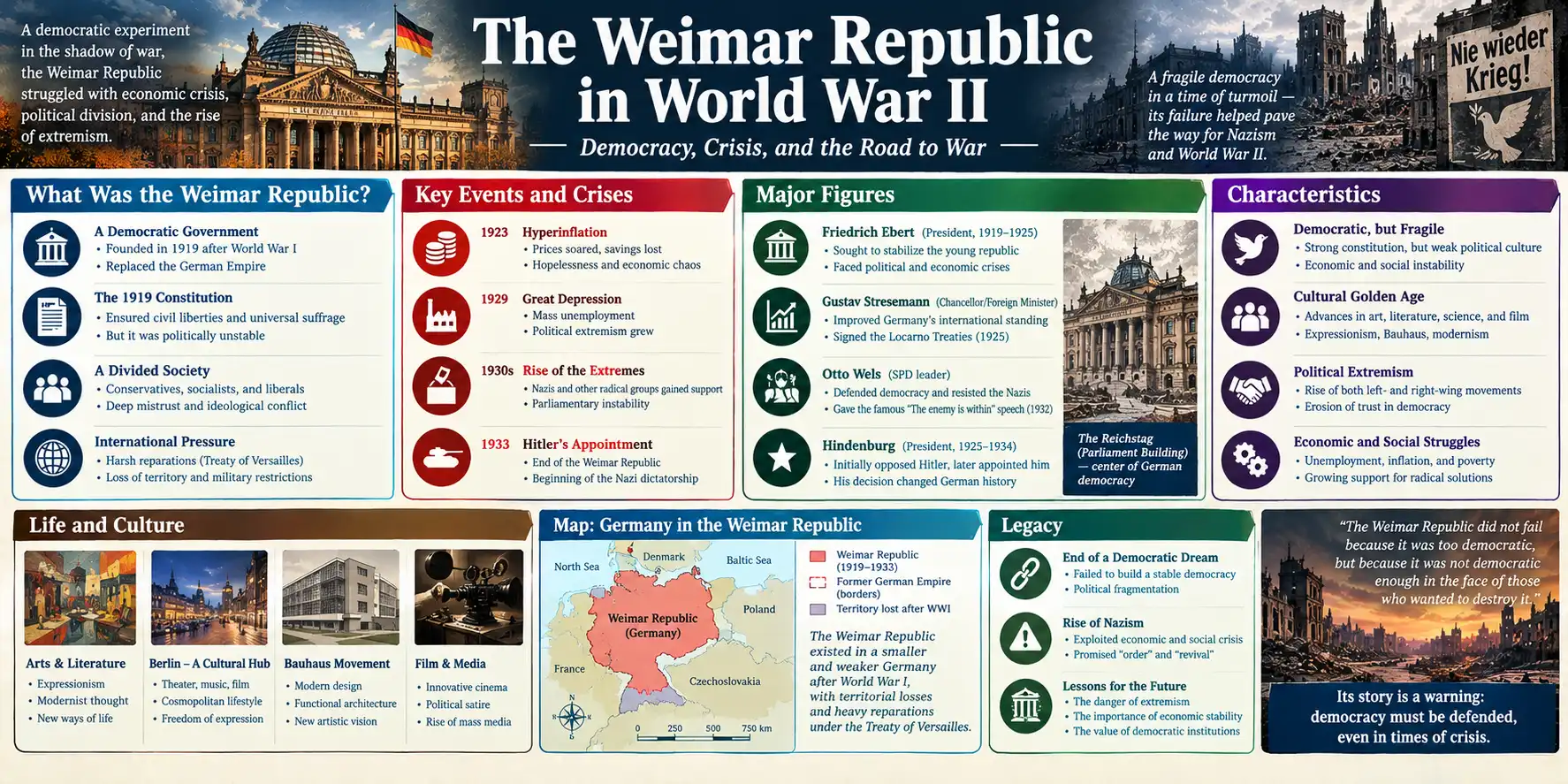
Wilhelm Marx and Weimar Leadership

Wilhelm Marx

A German lawyer, judge, and politician. Active as a prominent politician of the Catholic Centre Party (Deutsche Zentrumspartei), he served twice as Chancellor of Germany during the Weimar Republic. Leading a total of four cabinets between 1923–1925 and 1926–1928, he worked to address crises such as hyperinflation, the occupation of the Ruhr, the reparations issue, and political division. He served as the leader of the Centre Party from 1922 to 1928 and ran against Paul von Hindenburg in the 1925 German presidential election. In 1927, he achieved Germany's entry into the League of Nations and also promoted social policies, including the unemployment insurance system.

Timeline

Category
Element
Year Wilhelm Marx
1863
Birth of Wilhelm Marx (Period: January 15, 1863, Location: Cologne, Germany)
1888
Beginning of Career as Jurist and Judge (Age: 24 years old, Period: 1888–1921, Location: Cologne, Waldbröl, Simmern, Elberfeld, Düsseldorf, Limburg an der Lahn, Berlin)
1891
Marriage (Wilhelm Marx, Johanna Verkoyen, Age: 28 years old, Period: May 31, 1891, Location: Simmern (Germany))
1899
Political Activities in the Centre Party (Age: 35 years old, Period: 1899–1928, Location: Elberfeld, Düsseldorf, Prussia, Germany)
1914
World War I (Age: 50 years old, Period: 1914–1918, Location: Western Front, Belgium and France)
1917
Support for the 1917 Reichstag Peace Resolution (Age: 53 years old, Period: 1917, Location: Berlin, Reichstag of the German Empire)
1918
German Revolution (Age: 54 years old, Period: 1918–1919, Location: Various parts of Germany, especially Berlin, etc.)
Rhineland Separatist Movement (Age: 54 years old, Period: 1918 – 1920s, Location: Rhineland, Germany)
1919
Participation in the Weimar National Assembly (Age: 55 years old, Period: 1919–1920, Location: Germany, Weimar)
Support for the Acceptance of the Treaty of Versailles (Age: 55 years old, Period: 1919, Location: Germany and the Occupied Rhineland)
1922
Assuming the Leadership of the Centre Party (Wilhelm Marx, Age: 59 years old, Period: January 17, 1922, Location: Berlin, Germany)
1923
Occupation of the Ruhr (Age: 59 years old, Period: January 1923 – 1925, Location: Ruhr Region (Germany))
First Marx Cabinet (Age: 60 years old, Period: November 30, 1923 – January 15, 1925, Location: Berlin, Germany)
1924
Participation in the Dawes Plan (Age: 61 years old, Period: August 1924, Location: International Diplomacy centered around London)
1925
1925 German Presidential Election (Wilhelm Marx, Age: 61 years old, Period: 1925, Location: All of Germany)
Taking Office as Minister-President of Prussia (Wilhelm Marx, Age: 62 years old, Period: February – April 1925, Location: Prussia)
1926
Reichswehr Secret Military Cooperation Issue (Age: 62 years old, Period: 1926, Location: Relations between Germany and the Soviet Union)
Second Marx Cabinet (Age: 63 years old, Period: May 17, 1926 – June 29, 1928, Location: Berlin, Germany)
Referendum on the Expropriation of the Princes (Age: 63 years old, Period: June 1926, Location: All of Germany)
Germany's Admission to the League of Nations (Age: 63 years old, Period: September 8, 1926, Location: Geneva (Switzerland))
1927
Establishment of a Comprehensive Unemployment Insurance System (Age: 64 years old, Period: July 16, 1927, Location: Germany)
1928
Resignation as Chancellor and Retirement from Politics (Wilhelm Marx, Age: 64 years old, Period: 1928–1932, Location: Germany)
1933
National Union Trial (Age: 69 years old, Period: 1933–1935, Location: Nazi Germany)
Later Years under the Nazi Regime (Age: 69 years old, Period: 1933–1945, Location: Bonn, Germany)
1939
World War II (Age: 75 years old, Period: 1939–1945, Location: UK, France, North Africa, Mediterranean, Atlantic, etc.)
1946
Death of Wilhelm Marx (Age: 83 years old, Period: August 5, 1946)

Map

Category
Element
Europe World
europe map

Related Links

Other Languages

Comments