Gustav Stresemann and Weimar Diplomacy
Gustav Stresemann and Weimar Diplomacy

Gustav Stresemann

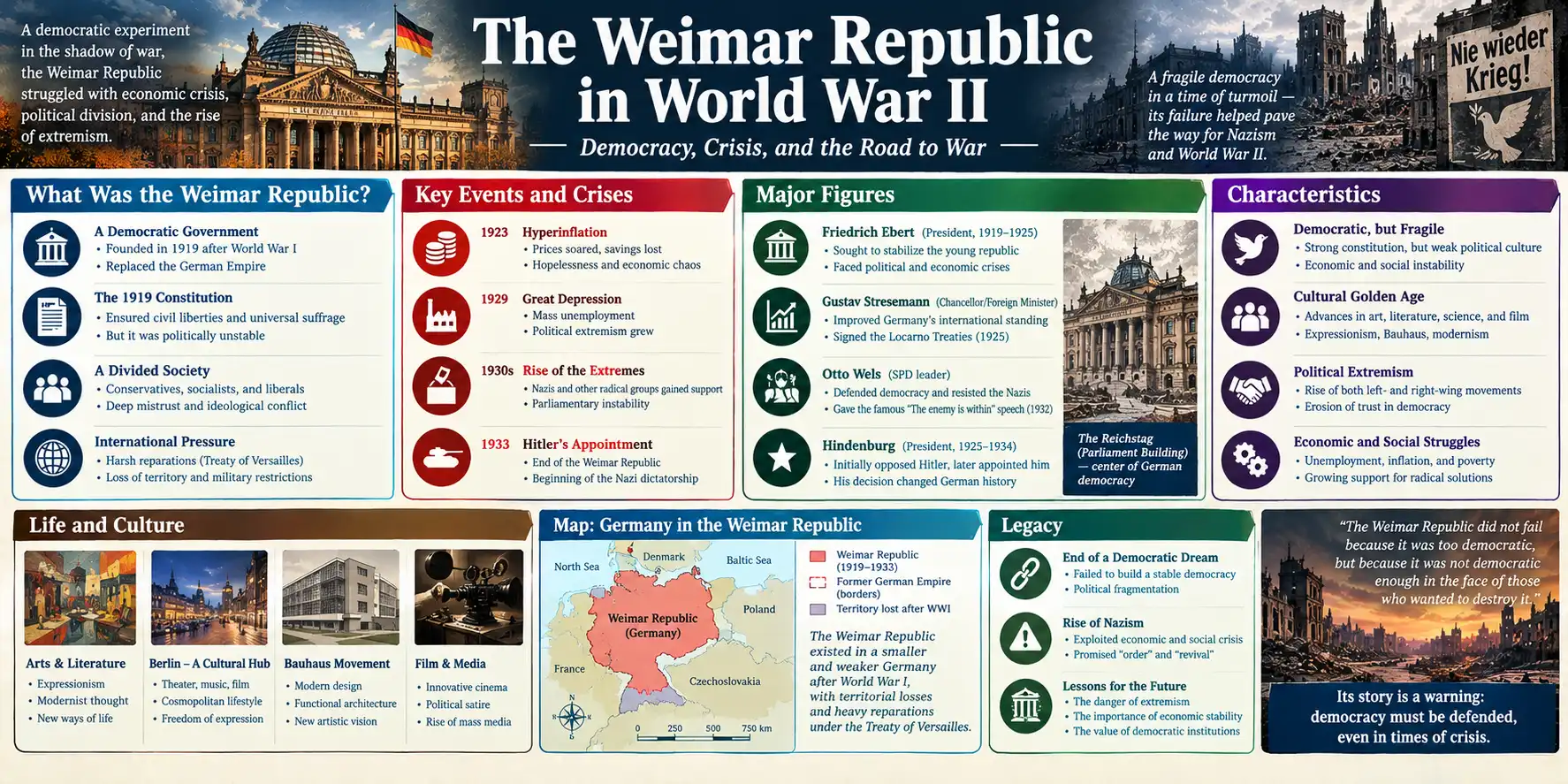
A German politician and diplomat, and one of the leading political leaders of the Weimar Republic era. He served as the leader of the German People's Party (DVP), became Chancellor and Foreign Minister in 1923, and subsequently served as Foreign Minister until his death. Before World War I, he supported Germany's economic and territorial expansion, but after the defeat, he shifted to a pragmatic policy aimed at restoring Germany's international standing through diplomacy. He brought an end to passive resistance under the occupation of the Ruhr, advanced currency stabilization and the resolution of the reparations issue, and contributed greatly to the Dawes Plan, the Locarno Treaties, and Germany's admission to the League of Nations. He was awarded the Nobel Peace Prize in 1926 along with France's Aristide Briand, becoming a politician who symbolized reconciliation and international cooperation in interwar Europe.

Timeline

Category
Element
Year Gustav Stresemann
1878
Birth of Gustav Stresemann (Period: May 10, 1878, Location: Berlin (Germany))
1902
Industrial Activities and Political Participation (Age: 23 years old, Period: 1902–1907, Location: Dresden, Berlin, etc.)
1903
Marriage (Gustav Stresemann, Käthe Kleefeld, Age: 25 years old, Period: October 20, 1903, Location: Kaiser Wilhelm Memorial Church (Berlin))
1907
Election to the Reichstag (Gustav Stresemann, Age: 28 years old, Period: 1907, Location: Reichstag of the German Empire)
1914
World War I (Age: 35 years old, Period: 1914–1918, Location: Western Front, Belgium and France)
1918
Formation of the German People's Party and Assumption of Party Leadership (Gustav Stresemann, Age: 39 years old, Period: 1918–1919, Location: Berlin, etc.)
1923
Occupation of the Ruhr (Age: 44 years old, Period: January 1923 – 1925, Location: Ruhr Region (Germany))
Hyperinflation in the Weimar Republic (Age: 44 years old, Period: 1923, Location: All of Germany)
Taking Office as Chancellor and Foreign Minister (Gustav Stresemann, Age: 45 years old, Period: August 13, 1923, Location: Berlin)
End of Passive Resistance in the Ruhr (Age: 45 years old, Period: September 26, 1923, Location: Berlin, Ruhr Region)
Rhenish Republic Movement (Age: 45 years old, Period: October 1923, Location: Rhineland centered around Aachen)
Currency Stabilization through the Rentenmark (Age: 45 years old, Period: November 1923, Location: All of Germany)
Resignation as Chancellor and Continuation as Foreign Minister (Gustav Stresemann, Age: 45 years old, Period: November 1923 – October 1929, Location: Berlin)
Beer Hall Putsch (Munich Putsch, Age: 45 years old, Period: November 8–9, 1923, Location: Munich)
1924
Adoption of the Dawes Plan (Age: 45 years old, Period: 1924, Location: London, Paris, Berlin, etc.)
1925
Locarno Treaties (Age: 47 years old, Period: October – December 1925, Location: Locarno (Switzerland), London (UK))
1926
Awarded the Nobel Peace Prize (Gustav Stresemann, Age: 47 years old, Period: 1926, Location: Oslo (Norway))
Treaty of Berlin (Age: 47 years old, Period: April 24, 1926, Location: Berlin)
Germany's Admission to the League of Nations (Age: 48 years old, Period: September 8, 1926, Location: Geneva (Switzerland))
1928
Participation in the Kellogg-Briand Pact (Age: 49 years old, Period: 1928, Location: Paris (France), etc.)
1929
Adoption of the Young Plan (Age: 50 years old, Period: 1929, Location: Paris, The Hague, etc.)
Death of Gustav Stresemann (Age: 51 years old, Period: October 3, 1929)

Map

Category
Element
Europe World
europe map

Related Links

Other Languages

Comments