Art and Music in World War II
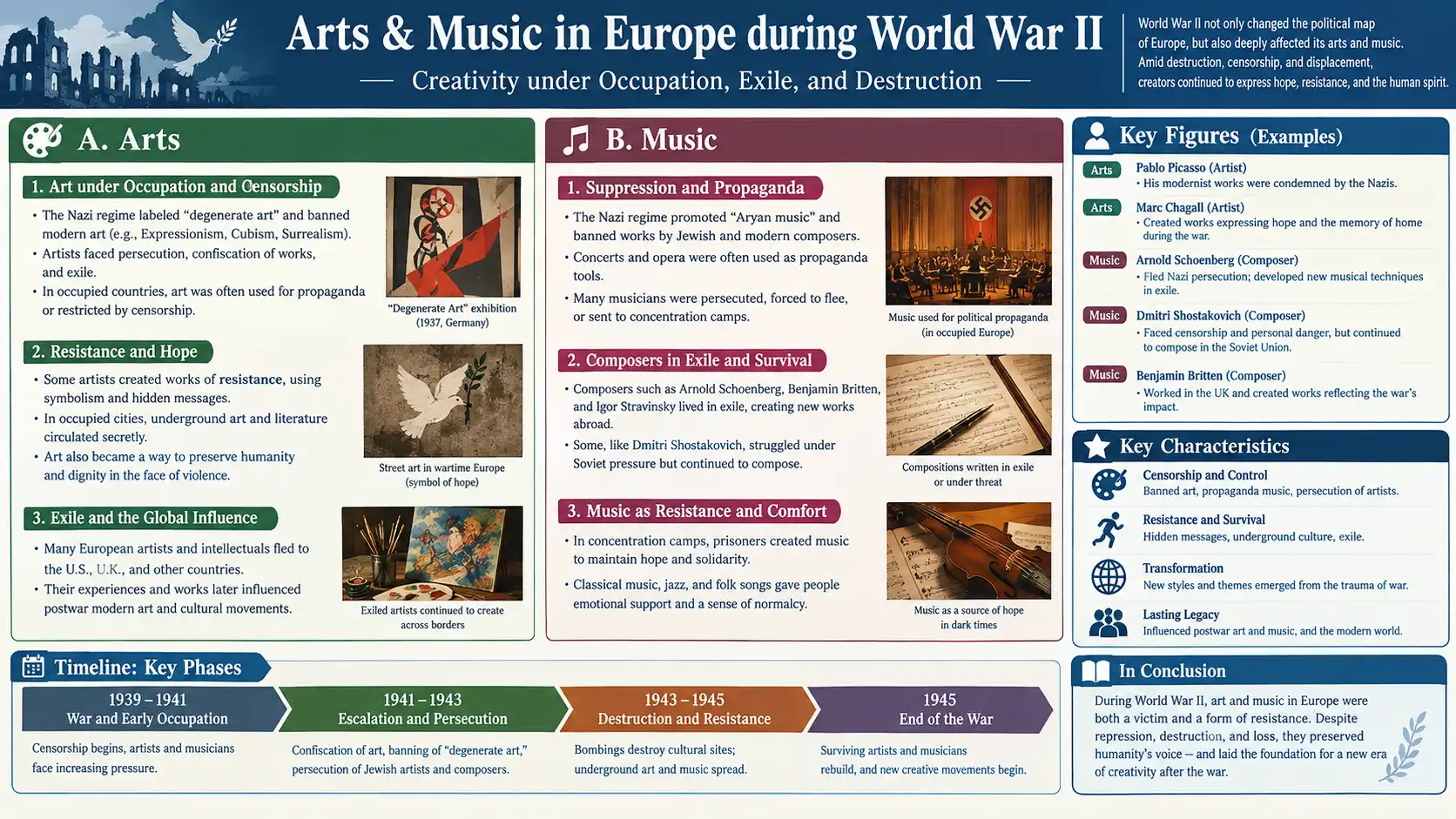
Arts & Music
During World War II, European arts and music served as both tools for Nazi propaganda and profound mediums of resistance, mourning, and survival. While the regime branded modern and avant-garde works as degenerate art and music, suppressing independent expression, many artists and composers used their crafts to document the devastation, protest totalitarianism, and preserve human dignity amidst immense conflict, exile, and loss.
People
Birth
Death
Origin
Age (Death)
| 1866 | |
|---|---|
| 1867 | |
| 1874 | |
| 1879 | |
| 1881 | |
| 1883 | |
| 1885 | |
| 1886 | |
| 1890 |
Timeline
| Category | |
|---|---|
| Element |
| Year | Arts & Music |
|---|---|
| 1524 |
German Peasants' War
|
| 1844 |
Silesian weavers' uprising
|
| 1866 |
Birth of Wassily Kandinsky (Period: December 16, 1866 (December 4 in the Old Style), Location: Moscow (currently Moscow, Russian Federation))
|
| 1867 |
Birth of Käthe Schmidt (Period: July 8, 1867, Location: Kaliningrad (Russia; known as Königsberg in the Kingdom of Prussia at the time of her birth))
|
| 1874 |
Birth of Arnold Schoenberg (Period: September 13, 1874, Location: Vienna (currently the Republic of Austria, City of Vienna))
|
| 1879 |
Birth of Paul Klee (Period: December 18, 1879, Location: Münchenbuchsee (currently a municipality in the Canton of Bern, Switzerland))
|
| 1881 |
Birth of Pablo Picasso (Period: October 25, 1881, Location: Malaga (Spain))
|
| 1883 |
Birth of Anton Webern (Period: December 3, 1883, Location: Vienna (Vienna))
|
| 1885 |
Birth of Alban Berg (Period: February 9, 1885, Location: Vienna (Austria))
|
| 1886 |
Study of law and economics
Art education in Berlin and Munich
Birth of Oskar Kokoschka (Period: March 1, 1886, Location: Pöchlarn (currently the Republic of Austria, Lower Austria))
|
| 1889 |
Ethnographic research trip to Vologda Governorate
|
| 1890 |
Beginning of art education
Beginning of activities as a musician
Birth of Egon Schiele (Period: June 12, 1890, Location: Tulln an der Donau (Austria))
|
| 1891 |
Relocation to Berlin and marriage
Marriage (Käthe Schmidt, Käthe Kollwitz)
|
| 1892 |
Marriage (Wassily Kandinsky, Anna (Anya) Chimiakina)
|
| 1893 |
Creation of "The Weavers' Uprising"
|
| 1896 |
Transition to becoming an artist
|
| 1898 |
Beginning of art education in Munich
Refusal of the gold medal for "The Weavers' Uprising" artwork
Exhibition and reception of "The Weavers' Uprising"
|
| 1899 |
Composition of "Verklärte Nacht" (Transfigured Night)
|
| 1901 |
Suicide of Carles Casagemas
Launch of "Arte Joven" in Madrid
Blue Period
Trip to Italy
Formation of Phalanx
Marriage to Mathilde Zemlinsky
Relocation to Berlin and "Gurre-Lieder"
Marriage (Arnold Schoenberg, Mathilde Zemlinsky)
|
| 1902 |
Meeting and joint activities with Gabriele Münter
Creation of the "Peasants' War" series
Musicology studies at the University of Vienna
|
| 1904 |
Rose Period
Admission to the Vienna School of Arts and Crafts
Composition education in Vienna
Studies under Arnold Schoenberg
Studies under Schoenberg
|
| 1906 |
Marriage to Lily Stumpf
Public debut of early works
Studies at the Academy of Fine Arts Vienna
Marriage (Paul Klee, Lily Stumpf)
|
| 1907 |
Creation of "Les Demoiselles d'Avignon"
Stay in Florence
Meeting with Gustav Klimt
|
| 1908 |
Controversy over "The Dreamers" and expulsion from the School of Arts and Crafts
Exhibition of "The Dreamers"
Advancement into the Viennese avant-garde art world
Transition to atonal music
Completion and publication of "Piano Sonata" Op. 1
Completion of "Passacaglia, Op. 1"
Development into atonal music
|
| 1909 |
Development of Cubism with Georges Black (Georges Braque)
Establishment of the New Artists' Association of Munich
|
| 1910 |
Relocation to Berlin
|
| 1911 |
Interrogation regarding the Mona Lisa theft
Relationship with the Blue Rider (Der Blaue Reiter)
Formation of the Blue Rider (Der Blaue Reiter)
Publication of "Concerning the Spiritual in Art"
Cohabitation with Wally Neuzil and stay in Český Krumlov
Relocation to Neulengbach
Premiere of "Passacaglia, Op. 1"
Marriage to Helene Nahowski
Marriage (Alban Berg, Helene Nahowski)
|
| 1912 |
Love affair with Alma Mahler
Return to Vienna and resumption of artistic activities
Composition of "Pierrot Lunaire"
Neulengbach affair and imprisonment
|
| 1913 |
Creation of "The Bride of the Wind"
Scandal Concert (Skandalkonzert)
|
| 1914 |
World War I
Trip to Tunisia and shift in color expression
Return to Moscow due to World War I
Composition of "Wozzeck"
Suspension of compositional activities due to World War I
Death in action of second son Peter Kollwitz
|
| 1915 |
Military service in World War I
Severe injury in World War I
Military service and suspension of creative activities due to World War I
Military service during World War I
Marriage (Anton Webern, Wilhelmine "Minna" Mörtl)
Con军事 service during World War I
Marriage to Edith Harms
Marriage (Egon Schiele, Edith Harms)
|
| 1916 |
Creation activities during World War I
|
| 1917 |
Production of stage design and costumes for the ballet "Parade"
Russian Civil War
Russian Revolution
Participation in arts administration after the Russian Revolution
Marriage (Wassily Kandinsky, Nina Nikolaevna Andreevskaya)
|
| 1918 |
Marriage to Olga Khokhlova
German Revolution and Bavarian Revolution (German Revolution of 1918)
German Revolution and end of World War I
Creation of the Alma doll
Creation of Death and the "Family"
Establishment of the Society for Private Musical Performances
Participation in Schoenberg's Society for Private Musical Performances
Large-scale exhibition at the Vienna Secession
Marriage (Pablo Picasso, Olga Khokhlova)
Death from the Spanish flu
Death of Egon Schiele
|
| 1919 |
First female full member and professor at the Prussian Academy of Arts
Appointment as professor at the Dresden Academy of Fine Arts
Assassination of German Communist Party leader Karl Liebknecht
|
| 1920 |
Re-emigration to Germany
Creation of the "War" series
Bullet damage to Rubens' painting "Bathsheba at the Fountain"
|
| 1921 |
Appointment as a Bauhaus professor
Antisemitic exclusion in Mattsee
Establishment of twelve-tone technique
|
| 1922 |
Participation in the International Congress of Progressive Artists
Full-scale introduction of twelve-tone technique
|
| 1923 |
Death of Mathilde Schönberg
|
| 1924 |
Formation of the Blue Four (Die Blaue Vier)
Creation of "Never Again War" (Nie wieder Krieg)
Travels and creative activities around the world
Premiere and success of excerpts from "Wozzeck"
Remarriage to Gertrud Kolisch
Marriage (Arnold Schoenberg, Gertrud Kolisch)
|
| 1925 |
Appointment as professor at the Prussian Academy of Arts
Full premiere of "Wozzeck"
|
| 1926 |
Composition of "Lyric Suite"
Composition of "String Trio, Op. 20"
|
| 1928 |
Trip to Egypt
Acquisition of German citizenship
Beginning of composition of "Lulu"
|
| 1929 |
International recognition through works like "Symphony, Op. 21"
|
| 1931 |
Appointment as a professor at the Düsseldorf Art Academy
Creation of municipal works for "Red Vienna"
|
| 1932 |
Completion of "The Grieving Parents" for Peter
|
| 1933 |
Persecution and dismissal of Klee by the Nazi regime
Return to Bern
Closure of the Bauhaus
Emigration to France
Suppression of artistic activities by the Nazi regime
Forced resignation from the Academy by the Nazi regime
Return to Judaism
Exile from Germany and persecution by the Nazi regime
Exile to America
Exile from Germany
Emigration to America
Suppression of "degenerate music" by the Nazis
Lectures on "The Path to New Music"
Activity restrictions during the Nazi era
|
| 1934 |
Later years of creation in France
Creation of "Death" series
Designation as a "degenerate artist" by the Nazis and exile
Exile to Prague
Austrian Civil War
|
| 1935 |
Acquisition of Czechoslovak citizenship
Composition of the Violin Concerto
Incompleteness of "Lulu" and posthumous premiere
Completion of the "Violin Concerto"
Severe infection and death of Alban Berg
Death of Alban Berg
|
| 1936 |
Spanish Civil War
Teaching at the University of California, Los Angeles
Gestapo threats and interrogation
|
| 1937 |
Creation of "Guernica"
Ostracization of works through the "Degenerate Art" (Entartete Kunst) exhibition
Prolific creation in later years
Confiscation of works due to "Degenerate Art"
Bombing of Guernica
|
| 1938 |
Creation of political allegorical works concerning the Munich Agreement
Exile to Britain
Anschluss (annexation of Austria)
|
| 1939 |
Acquisition of French citizenship
Anti-fascist art activities in Britain
|
| 1940 |
German occupation of Paris
Death of Paul Klee
|
| 1941 |
Marriage (Oskar Kokoschka, Olga Palkovska)
|
| 1942 |
Creation of "Do Not Grind the Seed"
Composition of "Ode to Napoleon Buonaparte"
|
| 1943 |
Evacuation from Berlin
Destruction of home and works due to the bombing of Berlin
|
| 1944 |
Liberation of Paris and joining the French Communist Party
Joining the French Communist Party
Death of Wassily Kandinsky
|
| 1945 |
Loss of son Peter in the war
Evacuation at the end of World War II
Death of Käthe Schmidt
Death of Anton Webern
Mitterndorf shooting incident
Death in Mitterndorf
|
| 1947 |
Acquisition of British citizenship
|
| 1949 |
Creation of "The Dove" and the peace movement
|
| 1950 |
Korean War
|
| 1951 |
Creation of "Massacre in Korea"
Death of Arnold Schoenberg
|
| 1953 |
Relocation to Villeneuve, Switzerland
|
| 1961 |
Marriage (Pablo Picasso, Jacqueline Roque)
|
| 1962 |
Tate Gallery retrospective exhibition
|
| 1966 |
Creation of a portrait of Konrad Adenauer
|
| 1967 |
Referendum on the City of Basel's purchase of Picasso's works
Creation and donation of the Chicago Picasso
|
| 1971 |
90th Anniversary Louvre Special Exhibition
|
| 1973 |
Death of Pablo Picasso
|
| 1980 |
Death of Oskar Kokoschka
|
Map
| Category | |
|---|---|
| Element |
Europe
World


Related Links
| Group | List |
|---|---|
| Western Europe | British Politics French Politics Jewish relief Nuclear Science |
| Central Europe | Nazi Germany Weimar Republic German Anti-Nazis Warsaw Ghetto Arts & Music |
Comments