British Politics in WWII
British Politics
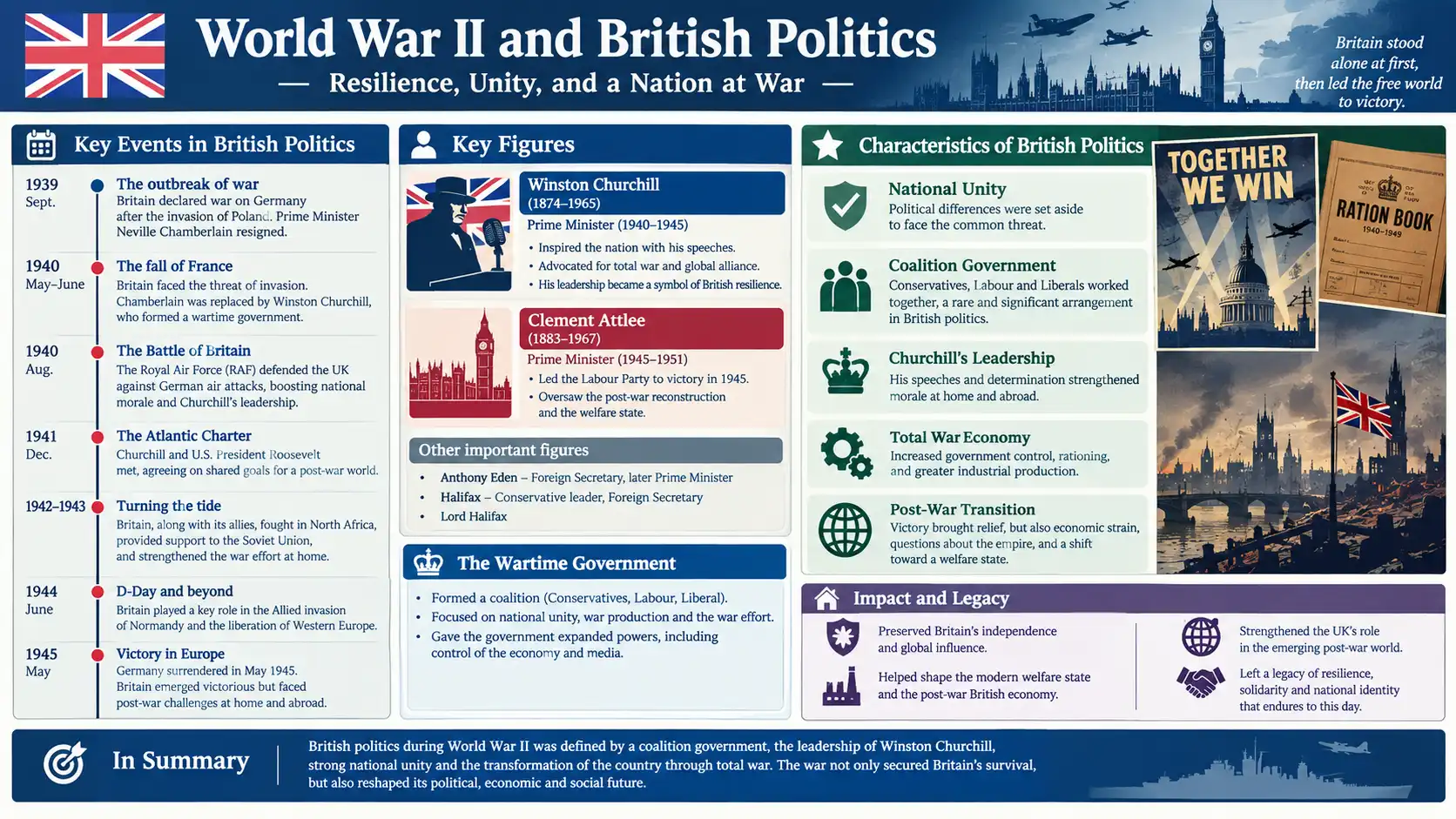
British politics during World War II underwent a dramatic transformation, shifting from Neville Chamberlain's pre-war appeasement strategy to a unified war mobilization. In May 1940, Winston Churchill formed an all-party wartime coalition government, uniting Conservatives, Labour, and Liberals to manage total war. Labour leaders like Clement Attlee and Ernest Bevin played critical roles in domestic administration, labor recruitment, and social planning. The coalition successfully coordinated the economy, armed forces, and home front, laying the structural groundwork for both victory over the Axis powers and post-war welfare state reforms.
People
Birth
Death
Origin
Age (Death)
| 1863 | |
|---|---|
| 1867 | |
| 1869 | |
| 1874 | |
| 1881 | |
| 1881 | |
| 1883 | |
| 1897 |
Timeline
| Category | |
|---|---|
| Element |
| Year | British Politics |
|---|---|
| 1863 |
Birth of David Lloyd George (Period: January 17, 1863, Location: Manchester, England)
|
| 1867 |
Birth of Stanley Baldwin (Period: August 3, 1867, Location: Bewdley, Worcestershire, England)
|
| 1869 |
Birth of Neville Chamberlain (Period: March 18, 1869, Location: Birmingham, England)
|
| 1874 |
Birth of Winston Churchill (Period: November 30, 1874, Location: Woodstock, Oxfordshire, England)
|
| 1881 |
Birth of Ernest Bevin (Period: March 9, 1881, Location: Winsford, Somerset, England (birthplace; near Exeter))
Birth of Edward Wood (Period: April 16, 1881, Location: Exeter, Devon, England (birthplace Powderham Castle near Kenton, south of Exeter))
|
| 1883 |
Birth of Clement Attlee (Period: January 3, 1883, Location: Putney, London Borough of Wandsworth, London, England)
|
| 1892 |
Marriage (Stanley Baldwin, Lucy Ridsdale)
|
| 1894 |
Graduation from the Royal Military College, Sandhurst (Winston Churchill)
|
| 1897 |
Service in the Malakand Field Force, India
Birth of Anthony Eden (Period: June 12, 1897, Location: Ferryhill, County Durham, England (birthplace Rushyford, current post town Ferryhill))
|
| 1898 |
Mahdist War
|
| 1899 |
Second Boer War
|
| 1900 |
Participation in the Bristol Socialist Movement
First Election to Parliament (Winston Churchill)
|
| 1904 |
Defection to the Liberal Party
|
| 1905 |
Transition to Social Welfare Work
|
| 1906 |
Marriage (Ernest Bevin, Florence Anne Townley)
|
| 1908 |
Unemployed Protest at Bristol Cathedral
First Election to Parliament (Stanley Baldwin)
Marriage (Winston Churchill, Clementine Hozier)
|
| 1909 |
Marriage (Edward Wood, Dorothy Evelyn Augusta Onslow)
|
| 1910 |
First Election to the House of Commons (Edward Wood)
Organization of Dockers and Transport Workers
|
| 1911 |
Marriage (Neville Chamberlain, Anne de Vere Cole)
Appointment as First Lord of the Admiralty (Winston Churchill)
Election to Birmingham City Council (Neville Chamberlain)
|
| 1914 |
World War I
|
| 1915 |
Failure of the Gallipoli Campaign
Appointment as Lord Mayor of Birmingham (Neville Chamberlain)
Participation and Injury in the Gallipoli Campaign
Military service in World War I
Frontline Service on the Western Front
|
| 1916 |
Injury at the Battle of Hanna
Injury in the Battle of the Somme
Appointment as Director of National Service (Neville Chamberlain)
|
| 1917 |
Held Posts as Minister of Munitions, Secretary of State for War, and Colonial Secretary
Appointment as Financial Secretary to the Treasury (Stanley Baldwin)
|
| 1918 |
Political Activities after World War I
First Election to the House of Commons (Neville Chamberlain)
|
| 1919 |
Appointment as Mayor of Stepney (Clement Attlee)
Irish War of Independence
Lowther Petition
|
| 1920 |
Growing Influence within the Labour Party
|
| 1921 |
Appointment as Parliamentary Under-Secretary of State for the Colonies (Edward Wood)
|
| 1922 |
Appointment as President of the Board of Education (Edward Wood)
Establishment of the Transport and General Workers' Union (TGWU)
Marriage (Clement Attlee, Violet Helen Millar)
Conservative Party Withdrawal of Support for the Lloyd George Coalition
First Election to the House of Commons (Clement Attlee)
|
| 1923 |
Appointment as Minister of Health (Neville Chamberlain)
First Baldwin Ministry
Appointment as Chancellor of the Exchequer (Neville Chamberlain)
Marriage (Anthony Eden, Beatrice Beckett)
First Election to the House of Commons (Anthony Eden)
|
| 1924 |
Return to the Gold Standard as Chancellor of the Exchequer
Appointment as Minister of Agriculture and Fisheries (Edward Wood)
Participation in the First MacDonald Ministry
Second Baldwin Ministry
|
| 1926 |
Appointment as Viceroy and Governor-General of India (Edward Wood)
1926 United Kingdom General Strike
1926 United Kingdom General Strike
|
| 1927 |
Trade Disputes and Trade Unions Act 1927
|
| 1929 |
Participation in the Second MacDonald Ministry
|
| 1930 |
Warnings Against German Rearmament
Indian Civil Disobedience Movement
Involvement in the Government of India Act
|
| 1931 |
Participation in the National Government
1931 Labour Party Split
Appointment as Parliamentary Under-Secretary of State for Foreign Affairs (Anthony Eden)
Second Round Table Conference
|
| 1934 |
Elevation to the House of Lords as Viscount Halifax (Edward Wood)
|
| 1935 |
Government of India Act 1935
Initiation of British Rearmament
Second Italo-Ethiopian War
Third Baldwin Ministry
Appointment as Leader of the Labour Party (Clement Attlee)
Hoare–Laval Pact Crisis
First Appointment as Foreign Secretary (Anthony Eden)
|
| 1936 |
Spanish Civil War
Remilitarization of the Rhineland
Jarrow March
Edward VIII Abdication Crisis
Realization of the Abdication of Edward VIII
|
| 1937 |
Promotion of Appeasement Policy
Promotion of British Rearmament
Retirement from Politics and Creation as Earl Baldwin of Bewdley (Stanley Baldwin)
Appointment as Conservative Leader and Prime Minister (Neville Chamberlain)
Nyon Conference
Halifax's Meeting with Hitler
|
| 1938 |
Support for Jewish Refugees during World War II
Appointment as Foreign Secretary (Edward Wood)
Resignation of Eden as Foreign Secretary (Anthony Eden)
Resignation as Foreign Secretary (Anthony Eden)
Annexation of Austria (Anschluss)
Munich Conference / Munich Agreement
Munich Crisis
Munich Crisis / Munich Agreement
Signing of the Munich Agreement
|
| 1939 |
German Disintegration of Czechoslovakia
German Occupation of Czechoslovakia
British Guarantee to Poland
British Safety/Security Guarantee to Poland
German Invasion of Poland and British Declaration of War
Outbreak of World War II
Leadership of the War Cabinet
Outbreak of World War II and Joining the War Coalition Cabinet
German Invasion of Poland
Outbreak of WWII and Return to First Lord of the Admiralty
|
| 1940 |
Norway Campaign
Participation in the War Cabinet as Lord President of the Council
1940 British War Cabinet Crisis
Declining the Prime Ministership in 1940 (Edward Wood)
Appointment as Minister of Labour and National Service (Ernest Bevin)
Norway Debate
Appointment as Prime Minister and Formation of the Coalition Government (Winston Churchill)
Appointment as Prime Minister (Winston Churchill)
Resignation as Prime Minister (Neville Chamberlain)
Dunkirk Evacuation and Peace Negotiations Debate
Dunkirk Evacuation
Battle of Britain
Death of Neville Chamberlain
Eden's Return as Wartime Foreign Secretary
Appointment as Foreign Secretary during World War II (Anthony Eden)
|
| 1941 |
Appointment as British Ambassador to the United States (Edward Wood)
Atlantic Charter
|
| 1942 |
Appointment as Deputy Prime Minister during World War II (Clement Attlee)
|
| 1943 |
Tehran Conference
|
| 1944 |
Creation as Earl of Halifax
|
| 1945 |
Yalta Conference
Death of David Lloyd George
Defeat in the 1945 General Election (Winston Churchill)
Potsdam Conference
Appointment as Foreign Secretary (Ernest Bevin)
Labour Victory in the 1945 General Election (Clement Attlee)
Formation of the First Attlee Ministry
|
| 1946 |
Greek Civil War
Establishment of the NHS
National Insurance Act and Nationalization of Key Industries
Clash with Molotov
Support for British Nuclear Weapons Development
"Iron Curtain" Speech (Winston Churchill)
Resignation as Ambassador to the United States (Edward Wood)
|
| 1947 |
Indian Independence and Partition
End of the Palestinian Mandate and Establishment of Israel
1948 Arab–Israeli War
Issue of the End of the Palestine Mandate
Participation in the Marshall Plan
Death of Stanley Baldwin
|
| 1948 |
Promotion of the Brussels Treaty
Berlin Blockade
Launch of the NHS
|
| 1949 |
Establishment of the North Atlantic Treaty Organization (NATO)
NATO Accession
|
| 1950 |
Korean War
1950 General Election and Second Attlee Ministry (Clement Attlee)
|
| 1951 |
Second Term as Prime Minister (Winston Churchill)
Appointment as Lord Privy Seal (Ernest Bevin)
Death of Ernest Bevin
Post-war Return as Foreign Secretary
Resignation as Prime Minister (Clement Attlee)
|
| 1952 |
Marriage (Anthony Eden, Clarissa Spencer-Churchill)
|
| 1953 |
Awarded the Nobel Prize in Literature (Winston Churchill)
|
| 1955 |
Resignation as Labour Leader and Creation as Earl Attlee (Clement Attlee)
Appointment as Prime Minister (Anthony Eden)
1955 General Election (Anthony Eden)
|
| 1956 |
Suez Crisis
Nationalization of the Suez Canal
Suez Crisis
Suez Crisis and Anglo-French Military Intervention
|
| 1957 |
Resignation as Prime Minister after the Suez Crisis (Anthony Eden)
Resignation as Prime Minister (Anthony Eden)
|
| 1959 |
Death of Edward Wood
|
| 1961 |
Creation as Earl of Avon
|
| 1965 |
Death of Winston Churchill
|
| 1967 |
Death of Clement Attlee
|
| 1977 |
Death of Anthony Eden
|
Map
| Category | |
|---|---|
| Element |
Europe
World


Related Links
| Group | List |
|---|---|
| Western Europe | British Politics French Politics Jewish relief Nuclear Science |
| Central Europe | Nazi Germany Weimar Republic German Anti-Nazis Warsaw Ghetto Arts & Music |
Comments