Marie Curie's Mobile Radiology Units on the Front Lines
Marie Curie's Mobile Radiology Units on the Front Lines

Marie Curie

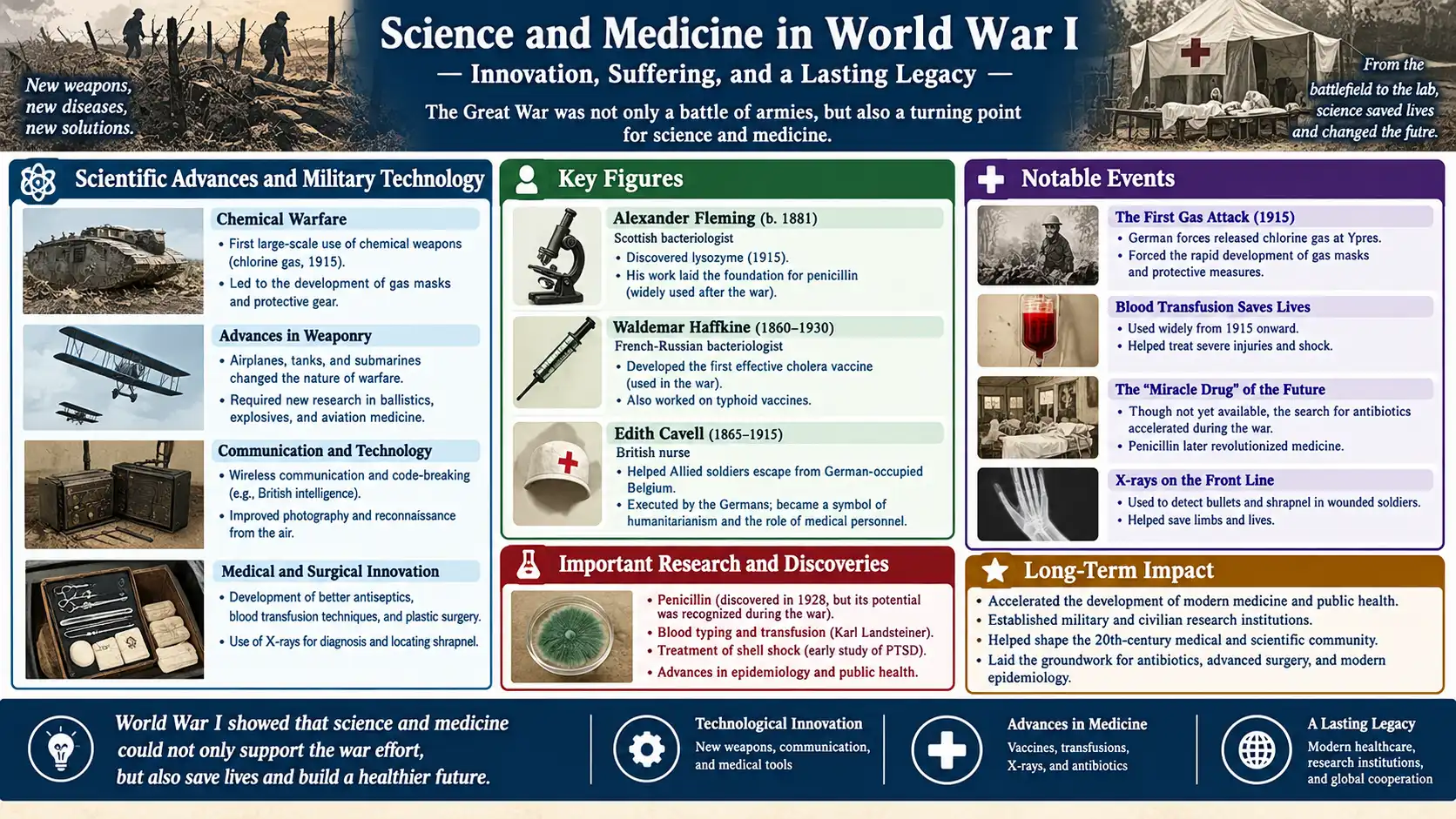
A Polish-born physicist and chemist who was active mainly in France. Together with her husband Pierre Curie, she advanced the study of radioactivity and discovered polonium and radium. In 1903, she was awarded the Nobel Prize in Physics jointly with Pierre Curie and Henri Becquerel, and in 1911, she won the Nobel Prize in Chemistry as a sole recipient. She was the first woman to win a Nobel Prize and the first person to win Nobel Prizes in two different scientific fields. During World War I, she developed mobile X-ray units known as "Petites Curies" to help diagnose wounded soldiers near the front lines, and after the war, she dedicated herself to advancing radiology and radiation research as well as training young researchers.

Timeline

Category
Element
Year Marie Curie
1867
Birth of Marie Curie (Period: November 7, 1867, Location: Warsaw, Poland)
1880
Studies at the Flying University (Age: 12 years old, Period: 1880s, Location: Warsaw, Poland)
1891
Physics and mathematics research at the University of Paris (Age: 23 years old, Period: 1891–1894, Location: Paris, France)
1894
Beginning of joint research with Pierre Curie (Age: 26 years old, Period: 1894–1895, Location: Paris, France)
1895
Marriage to Pierre Curie (Age: 27 years old, Period: July 26, 1895, Location: Sceaux (France))
Marriage (Marie Curie, Pierre Curie, Age: 27 years old, Period: July 26, 1895, Location: City Hall of Sceaux (France))
1896
Beginning of radioactivity research (Age: 28 years old, Period: 1896–1897, Location: Paris, France)
1898
Discovery of polonium (Age: 30 years old, Period: July 1898, Location: Paris, France)
Discovery of radium (Age: 31 years old, Period: December 1898, Location: Paris, France)
1903
Nobel Prize in Physics (Marie Curie, Age: 35 years old, Period: 1903, Location: Stockholm, Sweden)
1906
Accidental death of Pierre Curie (Age: 38 years old, Period: April 19, 1906, Location: Rue Dauphine, Paris)
Appointment as the first female professor at the University of Paris (Marie Curie, Age: 38 years old, Period: May 13, 1906, Location: Paris, France)
1909
Establishment and operation of the Radium Institute (Age: 41 years old, Period: 1909–1914, Location: Paris, France)
1911
Rejection of election to the French Academy of Sciences (Marie Curie, Age: 43 years old, Period: January 1911, Location: French Academy of Sciences, Paris)
The Langevin Affair (Age: 43 years old, Period: 1911, Location: Paris, France)
Nobel Prize in Chemistry (Marie Curie, Age: 43 years old, Period: 1911, Location: Stockholm, Sweden)
1914
World War I (Age: 46 years old, Period: 1914–1918, Location: Europe, Middle East, and Africa)
Radiological medical activities during World War I (Age: 46 years old, Period: 1914–1918, Location: Field hospitals in France and on the Western Front)
Development of Petite Curies (Age: 46 years old, Period: 1914–1915, Location: France and the Western Front)
1915
Popularization of wartime radiology (Age: 47 years old, Period: 1915–1918, Location: France and the Western Front)
1920
Health deterioration due to radiation exposure after World War I (Age: 52 years old, Period: 1920s–1934, Location: France)
Development of the Curie Institute (Age: 52 years old, Period: 1920s, Location: Paris, France)
1922
Participation in the International Committee on Intellectual Cooperation of the League of Nations (Age: 54 years old, Period: 1922–1934, Location: Geneva, Switzerland, etc.)
1929
Support for the Warsaw Radium Institute (Age: 61 years old, Period: 1929–1932, Location: Warsaw, Poland)
1934
Death of Marie Curie (Age: 66 years old, Period: July 4, 1934 (Sancellemoz Sanatorium, Passy, Haute-Savoie, France))

Map

Category
Element
Europe World
europe map

Related Links

Other Languages

Comments