British Political Shift in World War I
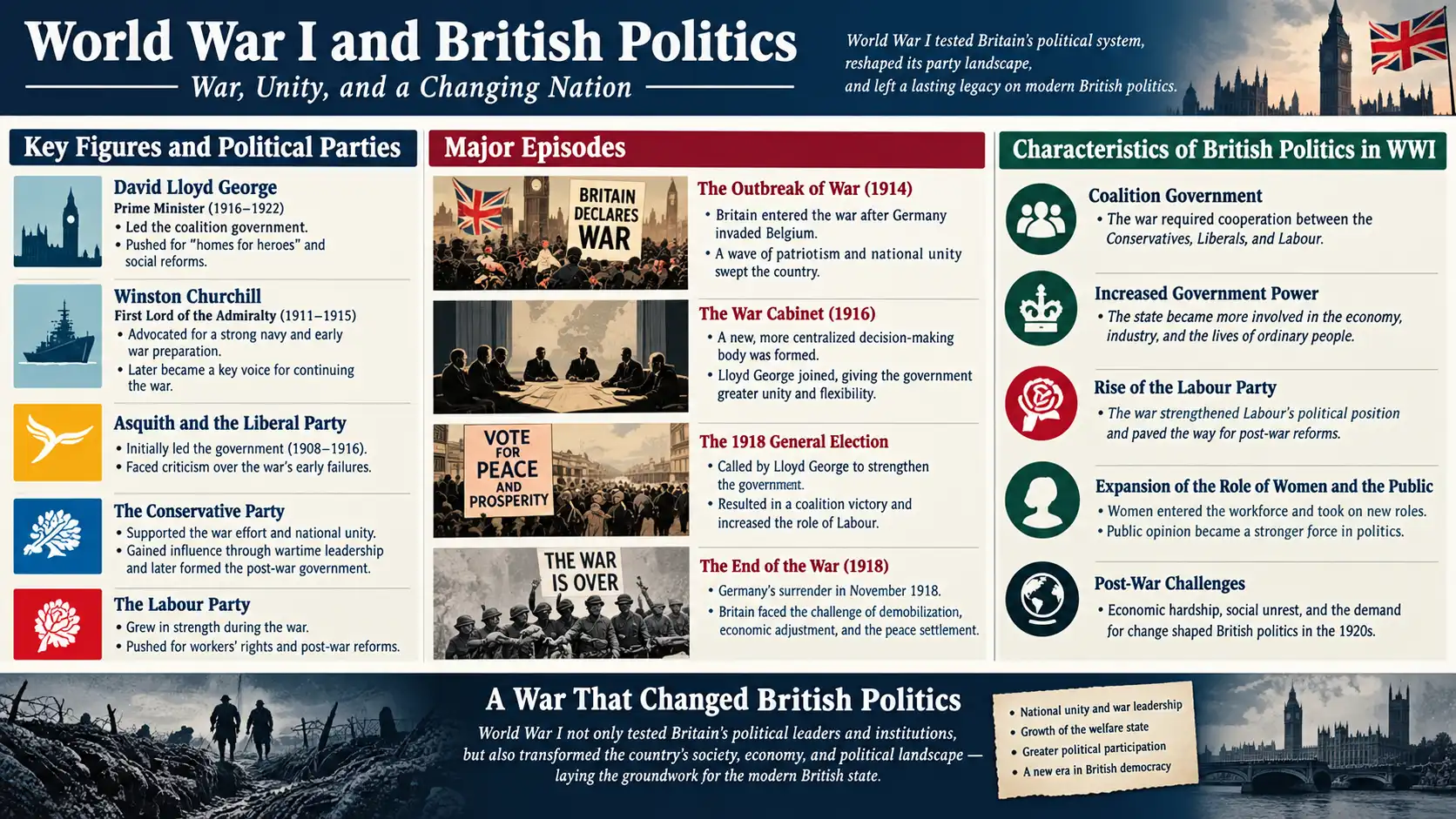
British Politics
During World War I, British politics transformed from a partisan Liberal system into a centralized war government. Prime Minister H. H. Asquith initially led the nation into war in 1914, but escalating shell shortages and military setbacks forced the creation of a coalition government in 1915. Increasing pressure for decisive leadership led to David Lloyd George replacing Asquith in December 1916. Lloyd George established a small, efficient War Cabinet that streamlined state intervention, total war mobilization, and industrial production. This wartime political evolution ultimately fractured the Liberal Party, paved the way for Conservative dominance, and enabled the Labour Party's rise in post-war Britain.
People
Birth
Death
Origin
Age (Death)
| 1850 | |
|---|---|
| 1852 | |
| 1858 | |
| 1863 | |
| 1874 |
Timeline
| Category | |
|---|---|
| Element |
| Year | British Politics |
|---|---|
| 1850 |
Birth of Horatio Herbert Kitchener (Period: June 24, 1850, Location: Near Listowel, Ireland (Ballylongford, County Kerry))
|
| 1852 |
Birth of Herbert Henry Asquith (Period: September 12, 1852, Location: Morley, West Yorkshire, England (now part of the City of Leeds))
|
| 1858 |
Birth of Andrew Bonar Law (Period: September 16, 1858, Location: Kingston, New Brunswick, Canada (present-day Rexton))
Birth of Andrew Bonar Law (Period: September 16, 1858, Location: Five Rivers, New Brunswick, Canada (formerly Kingston))
|
| 1863 |
Birth of David Lloyd George (Period: January 17, 1863, Location: Manchester, England)
|
| 1870 |
Service with the French Army Ambulance Corps
Relocation to Scotland (Andrew Bonar Law)
Success in the Iron and Steel Industry
Relocation to Scotland and Employment in Iron and Steel Industry (Andrew Bonar Law)
|
| 1871 |
Enlistment in the Royal Engineers
|
| 1874 |
President of the Oxford Union (Herbert Henry Asquith)
Palestine Survey Project
Birth of Winston Leonard Spencer Churchill (Period: November 30, 1874, Location: Woodstock, Oxfordshire, England (Blenheim Palace))
|
| 1877 |
Marriage (Herbert Henry Asquith, Helen Kelsall Melland)
|
| 1881 |
Mahdist War
|
| 1883 |
Service with the Egyptian Army
|
| 1884 |
Qualification as a Solicitor (David Lloyd George)
Gordon Relief Expedition
|
| 1886 |
Election to Parliament for East Fife (Herbert Henry Asquith)
Governor-General of Eastern Sudan (Horatio Herbert Kitchener)
|
| 1888 |
Parnell Commission
Marriage (David Lloyd George, Margaret Owen)
|
| 1890 |
Campaign for Disestablishment of the Church in Wales
Election to Parliament (David Lloyd George)
|
| 1891 |
Marriage (Andrew Bonar Law, Annie Pitcairn Robley)
|
| 1892 |
Home Secretary (Herbert Henry Asquith)
Sirdar of the Egyptian Army (Horatio Herbert Kitchener)
|
| 1893 |
Featherstone Massacre
Graduation from Royal Military College, Sandhurst and Military Career (Winston Leonard Spencer Churchill)
|
| 1894 |
Marriage (Herbert Henry Asquith, Margot Tennant)
|
| 1897 |
Malakand Field Force Operations in Northwest India
|
| 1898 |
Fashoda Incident
Battle of Omdurman
|
| 1899 |
Second Boer War
Liberal Party Split over the Boer War
Governor-General of Sudan (Horatio Herbert Kitchener)
Chief of Staff in South Africa (Horatio Herbert Kitchener)
Prisoner of War Escape in the Second Boer War
|
| 1900 |
Scorched Earth Policy in the Second Boer War
First Election to the House of Commons (Andrew Bonar Law)
First Election to Parliament (Winston Leonard Spencer Churchill)
|
| 1902 |
Commander-in-Chief, India (Horatio Herbert Kitchener)
Tariff Reform Controversy
Parliamentary Secretary to the Board of Trade (Andrew Bonar Law)
|
| 1904 |
Controversy with Curzon over Command of the Indian Army
Defection to the Liberal Party
|
| 1905 |
Chancellor of the Exchequer and Securing Funding for Social Reform (Herbert Henry Asquith)
President of the Board of Trade (David Lloyd George)
|
| 1908 |
Expansion of Old-Age Pensions
Chancellor of the Exchequer (David Lloyd George)
Prime Minister (Herbert Henry Asquith)
Marriage (Winston Leonard Spencer Churchill, Clementine Hozier)
|
| 1909 |
Constitutional Crisis over the People's Budget
People's Budget
1909 People's Budget Crisis
Promotion to Field Marshal
Introduction of the People's Budget
|
| 1910 |
1910 General Elections and Constitutional Crisis (Herbert Henry Asquith)
|
| 1911 |
Parliament Act 1911
National Insurance Act 1911
Passage of the National Insurance Act
Consul-General in Egypt (Horatio Herbert Kitchener)
Irish Home Rule Issue
First Lord of the Admiralty (Winston Leonard Spencer Churchill)
Siege of Sidney Street
Leader of the Conservative Party (Andrew Bonar Law)
|
| 1912 |
Irish Home Rule Crisis
Marconi Scandal
Support for the Ulster Covenant
Irish Home Rule Crisis and the Third Home Rule Bill
Hardline Stance on the Ulster Question
Union of the Conservative Party and Liberal Unionist Party
|
| 1914 |
Recruitment of Kitchener's Army
Expansion of Munitions Production
World War I Western Front
British Entry into World War I and General Mobilization
Secretary of State for War (Horatio Herbert Kitchener)
Defense of Antwerp
|
| 1915 |
Battle of Gallipoli
World War I Shell Crisis
Political Conflict over the Dardanelles Campaign
Formation of the Coalition Government in World War I
Military Service on the Western Front
Gallipoli Campaign
1915 Shell Crisis
Formation of the First Coalition Government
Minister of Munitions (David Lloyd George)
Secretary of State for the Colonies (Andrew Bonar Law)
1915 Shell Crisis and Formation of Coalition Government
Appointment as Colonial Secretary during WWI (Andrew Bonar Law)
|
| 1916 |
Post-Easter Rising Irish Question
Strengthening of the War Cabinet and Total War Movement
Easter Rising
Planned Mission to Russia
Death of Horatio Herbert Kitchener
Sinking of HMS Hampshire
Fall of the Asquith Government
1916 Change of Prime Minister
Chancellor of the Exchequer (Andrew Bonar Law)
Appointment as Chancellor of the Exchequer and Leader of the House of Commons (Andrew Bonar Law)
Resignation as Prime Minister (Herbert Henry Asquith)
Prime Minister of the United Kingdom (David Lloyd George)
|
| 1917 |
Russian Civil War
Death of Two Sons in Action
Second Battle of Gaza
|
| 1918 |
Maurice Debate
1918 General Election and the "Coupon Election" (David Lloyd George)
1918 General Election (Andrew Bonar Law)
|
| 1919 |
Greco-Turkish War
Irish War of Independence
Paris Peace Conference
Anglo-Irish War
Treaty of Versailles
|
| 1920 |
Liberal Party Rebuilding Movement and the "New Deal" Proposal
|
| 1921 |
Resignation as Party Leader and Leader of the House of Commons (Andrew Bonar Law)
Resignation as Conservative Leader and Leader of the House of Commons (Andrew Bonar Law)
Anglo-Irish Treaty and Establishment of the Irish Free State
|
| 1922 |
Anglo-American War Debt Issue
Handling of Anglo-American War Debts
Second Premiership
Chanak Crisis
Collapse of the Lloyd George Coalition
Conservative Withdrawal from Coalition and Resignation of Lloyd George (Andrew Bonar Law)
Resignation as Prime Minister (David Lloyd George)
Carlton Club Meeting
Carlton Club Meeting and Collapse of Coalition Government
Prime Minister of the United Kingdom (Andrew Bonar Law)
1922 General Election (Andrew Bonar Law)
|
| 1923 |
Resignation of the Bonar Law Government (Andrew Bonar Law)
Resignation as Prime Minister and Death (Andrew Bonar Law)
Resignation as Prime Minister (Andrew Bonar Law)
Death of Andrew Bonar Law
Death of Andrew Bonar Law
|
| 1925 |
Elevation to Earl of Oxford and Asquith
|
| 1926 |
Resignation as Liberal Party Leader (Herbert Henry Asquith)
|
| 1928 |
Death of Herbert Henry Asquith
|
| 1933 |
Pre-WWII Anti-Nazi Rearmament Campaign
|
| 1936 |
Abdication Crisis
Meeting with Adolf Hitler
|
| 1938 |
Munich Agreement and Appeasement Policy
|
| 1939 |
World War II
|
| 1940 |
Norway Debate
Dunkirk Evacuation
Prime Minister and Formation of War Cabinet (Winston Leonard Spencer Churchill)
|
| 1941 |
Allied Allied Summit Diplomacy
Agreement on the Atlantic Charter with the US
|
| 1943 |
Marriage (David Lloyd George, Frances Louise Stevenson)
|
| 1945 |
Elevation to Earl Lloyd-George of Dwyfor
Death of David Lloyd George
End of World War II and 1945 General Election (Winston Leonard Spencer Churchill)
|
| 1946 |
"Iron Curtain" Speech (Winston Leonard Spencer Churchill)
|
| 1953 |
Nobel Prize in Literature (Winston Leonard Spencer Churchill)
|
| 1965 |
Death of Winston Leonard Spencer Churchill
|
| Unknown |
Marriage (Horatio Herbert Kitchener, None, Period: Never Married, Location: N/A)
|
Map
| Category | |
|---|---|
| Element |
Europe
World


Related Links
| Group | List |
|---|---|
| Western Europe | French Politics British Politics Poet and Writer Science and Medicine |
| Central Europe | German Leader Emperors of Austria-Hungary The Sarajevo Incident Science and Medicine |
Comments