Scientific Innovations and Medical Advances in World War I

Scientific Innovations and Medical Advances in World War I

Science and Medicine

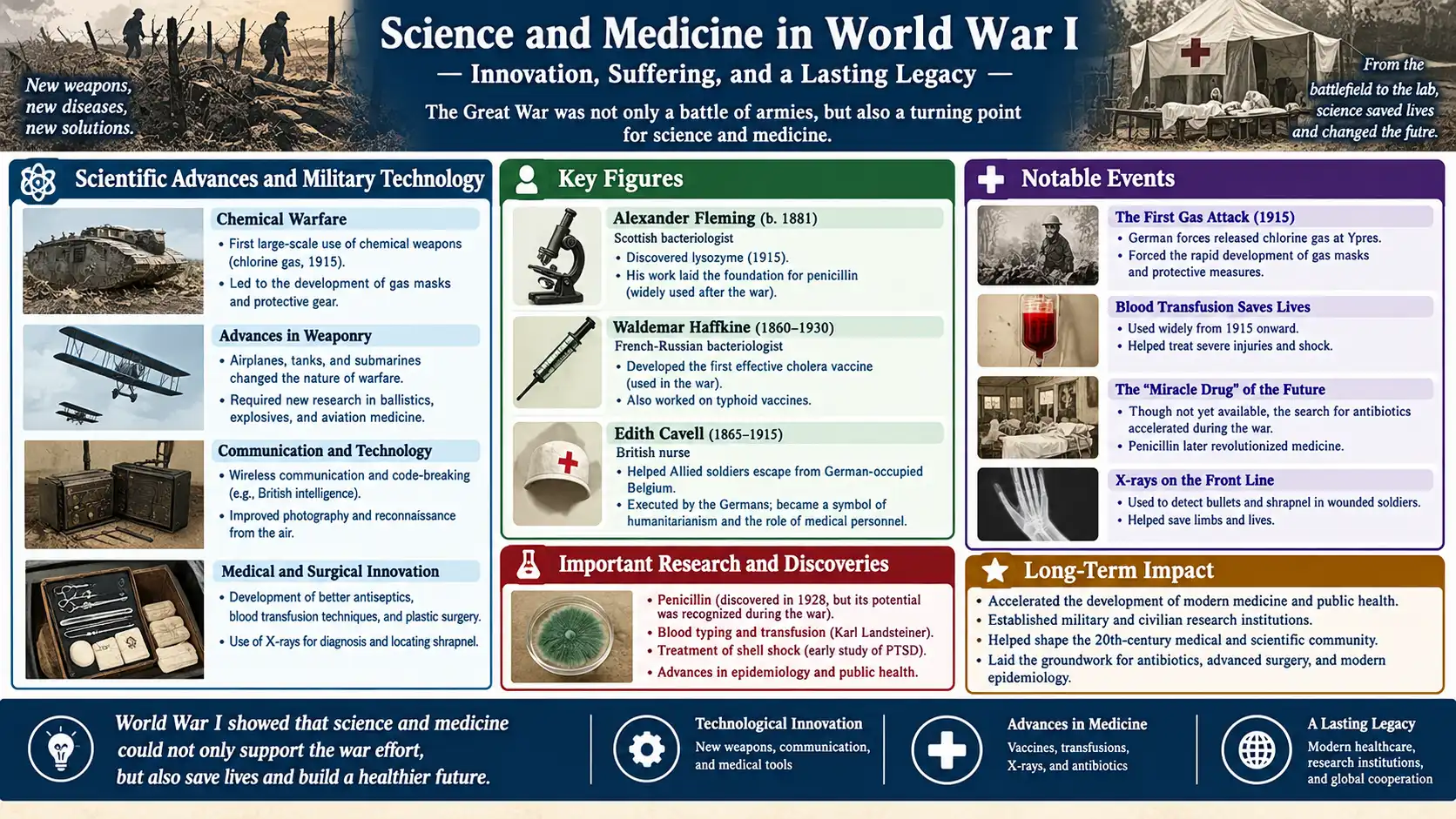
World War I drove rapid advancements in science and medicine to address unprecedented wartime casualties and logistical demands. Mobile X-ray units, known as "Petites Curies," enabled field surgeons to locate shrapnel and fractures quickly. Antiseptic breakthroughs, such as the Carrel-Dakin solution, prevented fatal wound infections, while improved blood transfusion techniques and blood banking allowed crucial life-saving interventions near the front lines. Meanwhile, innovations in sound ranging and sonar technology transformed naval and artillery operations, demonstrating how scientific research was mobilized for both military strategy and trauma medicine.

People

Birth Death Origin Age (Death)
1584
1867
1871
1872
1873

Timeline

Category
Element
Year Science and Medicine
1584
Birth of Charles de Lorme (Period: January 1, 1584, Location: Moulins, France)
1600
Medical research at the University of Montpellier
1606
Appointment as court physician to Henry IV (Charles de Lorme)
1610
Medical care for royal and noble members of the Medici family
1618
Thirty Years' War
1619
Plague outbreak in Paris in 1619
Invention of the plague doctor protective suit
1633
Development of the Bourbon-l'Archambault thermal baths
Development of balneotherapy in Bourbon-l'Archambault
1635
Franco-Spanish War
1662
Marriage (Charles de Lorme, details unknown (third marriage))
1678
1867
Birth of Marie Curie (Period: November 7, 1867, Location: Warsaw, Poland)
1871
Birth of Ernest Rutherford (Period: August 30, 1871, Location: Brightwater, Tasman District, New Zealand)
1872
Birth of Paul Langevin (Period: January 23, 1872, Location: Paris, France)
1873
Birth of Alexis Carrel (Period: June 28, 1873, Location: Sainte-Foy-lès-Lyon, France)
1880
Studies at the Flying University
1888
Studies at the École de Physique et de Chimie
1890
Medical education at the University of Lyons
1891
Physics and mathematics research at the University of Paris
1893
Admission to the École Normale Supérieure (Paul Langevin)
1894
Beginning of joint research with Pierre Curie
1895
Beginning of research at the Cavendish Laboratory, University of Cambridge
Marriage to Pierre Curie
Marriage (Marie Curie, Pierre Curie)
1896
Beginning of radioactivity research
1897
Research at the Cavendish Laboratory
1898
Radioactivity research at McGill University
Discovery of polonium
Marriage (Paul Langevin, Emma Jeanne Desfosses)
Discovery of radium
1899
Discovery of radon
1900
Introduction and popularization of the theory of relativity in France
Marriage (Ernest Rutherford, Mary Georgina Newton)
1902
Doctoral thesis "Researches on Ionized Gases"
Experience of "miraculous healing" in Lourdes
Conflict with the French medical establishment and emigration to North America (Alexis Carrel)
Establishment of vascular suture technique
1903
Nobel Prize in Physics (Marie Curie)
1904
Appointment as Professor at the Collège de France (Paul Langevin)
Transplant research at the University of Chicago
1906
Research at the Rockefeller Institute for Medical Research
Accidental death of Pierre Curie
Appointment as the first female professor at the University of Paris (Marie Curie)
1907
Atomic structure research at the University of Manchester
1908
Nobel Prize in Chemistry (Ernest Rutherford)
1909
Establishment and operation of the Radium Institute
Shift in atomic structure understanding through the gold foil experiment
1910
Research on long-term cell maintenance through tissue culture
1911
Rejection of election to the French Academy of Sciences (Marie Curie)
The Langevin Affair
Nobel Prize in Chemistry (Marie Curie)
Proposal of the Rutherford model of the atom
1912
Nobel Prize in Physiology or Medicine (Alexis Carrel)
1913
Marriage (Alexis Carrel, Anne-Marie-Laure Gourlez de La Motte)
1914
Radiological medical activities during World War I
Development of Petite Curies
Submarine detection research during World War I
Military research during World War I
Research on submarine detection using ultrasound
Activities as a military physician in World War I
1915
Popularization of wartime radiology
Development of the Carrel-Dakin method during World War I
1917
Realization of artificial nuclear reactions
Success in artificial nuclear reactions
1919
Appointment as Director of the Cavendish Laboratory (Ernest Rutherford)
Naming of the proton and advancement of nuclear reaction research
1920
Health deterioration due to radiation exposure after World War I
Development of the Curie Institute
1922
Participation in the International Committee on Intellectual Cooperation of the League of Nations
1926
Appointment as Director of ESPCI (Paul Langevin)
1929
Support for the Warsaw Radium Institute
1930
Activities as an anti-fascist intellectual
Research on the "artificial heart" with Lindbergh
1932
Development of nuclear physics at the Cavendish Laboratory
1934
Formation of the Vigilance Committee of Anti-Fascist Intellectuals
Election as a member of the French Academy of Sciences
Death of Marie Curie
1935
Publication of "Man, The Unknown"
Development of organ perfusion device with Lindbergh
1937
Deterioration of condition in later years due to an acute hernia
1939
World War II
Return to France and activities at the Ministry of Health (Alexis Carrel)
1940
Dismissal and house arrest by the Vichy regime
1941
Establishment of the French Foundation for the Study of Human Problems under the Vichy regime
Leadership of the French Foundation for the Study of Human Problems
1944
Return to public service after World War II
Joining the French Communist Party and post-war activities
Suspicions of collaboration with Germany after the Liberation of France
Death of Alexis Carrel
1946
Death of Paul Langevin
Unknown
Controversy over antimony treatment as a court physician (Period: First half of the 17th century, Location: Paris, France)
Interactions with Cardinal Richelieu and Pierre Séguier (Period: First half of the 17th century, Location: Paris, France)
Activities as court physician to Louis XIII and Louis XIV (Period: First half to mid-17th century, Location: Paris, France)
Activities related to medical care and health regimens (Period: Mid-17th century, Location: Various regions of France)

Map

Category
Element
Europe World
europe map

Related Links

Other Languages

Comments