Alexis Carrel's Antiseptic Breakthrough for Battlefield Wounds
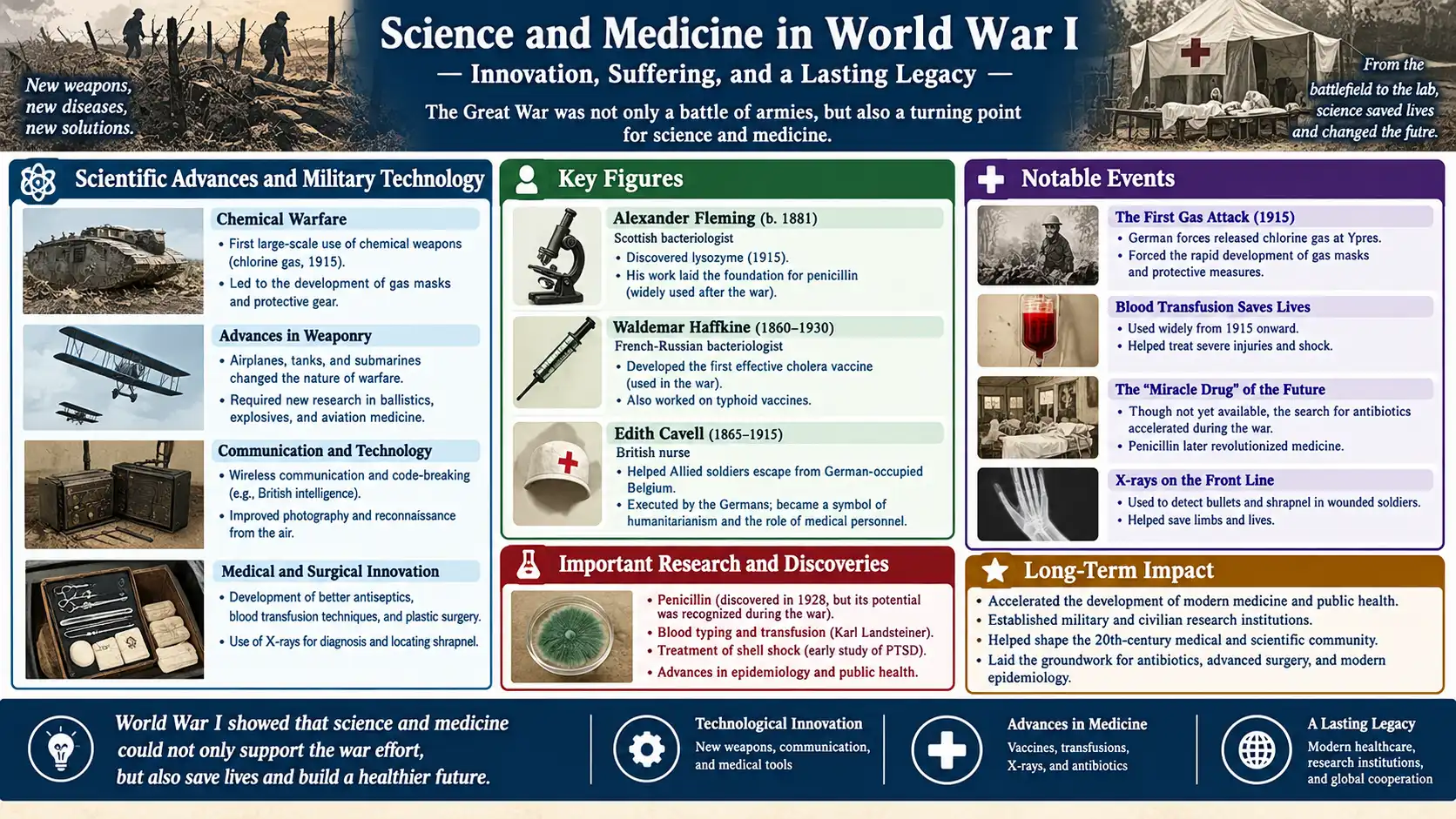
Alexis Carrel's Antiseptic Breakthrough for Battlefield Wounds

Alexis Carrel

A French surgeon, biologist, and physiologist. He significantly advanced vascular suture techniques and gained world renown for his work in experimental surgery, including organ and vascular transplantation as well as tissue culture. He conducted research at the Rockefeller Institute for Medical Research starting in 1906 and was awarded the Nobel Prize in Physiology or Medicine in 1912 for his work on vascular sutures and organ and vessel transplantation. During World War I, he served as a major in the French Army Medical Corps and developed the Carrel-Dakin method for treating infected battlefield wounds alongside chemist Henry Drysdale Dakin. In his later years, he wrote about religious thought and eugenics and headed the French Foundation for the Study of Human Problems under the Vichy regime, which led to post-war criticism for his involvement in collaboration.

Timeline

Category
Element
Year Alexis Carrel
1873
Birth of Alexis Carrel (Period: June 28, 1873, Location: Sainte-Foy-lès-Lyon, France)
1890
Medical education at the University of Lyons (Age: 16 years old, Period: 1890s–1900, Location: Lyons, France)
1902
Experience of "miraculous healing" in Lourdes (Age: 28 years old, Period: 1902, Location: Lourdes, France)
Conflict with the French medical establishment and emigration to North America (Alexis Carrel, Age: 28 years old, Period: 1902–1906, Location: Lyons, France / Chicago and New York, United States)
Establishment of vascular suture technique (Age: 28 years old, Period: 1902, Location: Lyons, France)
1904
Transplant research at the University of Chicago (Age: 30 years old, Period: 1904–1906, Location: Chicago, United States)
1906
Research at the Rockefeller Institute for Medical Research (Age: 32 years old, Period: 1906–1939, Location: New York, United States)
1910
Research on long-term cell maintenance through tissue culture (Age: 36 years old, Period: 1910s–1920s, Location: Rockefeller Institute for Medical Research, New York)
1912
Nobel Prize in Physiology or Medicine (Alexis Carrel, Age: 38 years old, Period: 1912, Location: Stockholm, Sweden)
1913
Marriage (Alexis Carrel, Anne-Marie-Laure Gourlez de La Motte, Age: 39 years old, Period: c. 1913, Location: France)
1914
World War I (Age: 40 years old, Period: 1914–1918, Location: Europe, Middle East, and Africa)
Activities as a military physician in World War I (Age: 40 years old, Period: 1914–1918, Location: France)
1915
Development of the Carrel-Dakin method during World War I (Age: 41 years old, Period: 1915–1918, Location: French military medical facilities)
1930
Research on the "artificial heart" with Lindbergh (Age: 56 years old, Period: 1930s, Location: New York, United States)
1935
Publication of "Man, The Unknown" (Age: 61 years old, Period: 1935, Location: New York, United States)
Development of organ perfusion device with Lindbergh (Age: 61 years old, Period: 1935, Location: New York, United States)
1939
World War II (Age: 65 years old, Period: 1939–1945, Location: UK, France, Atlantic, North Africa, Mediterranean, and Europe)
Return to France and activities at the Ministry of Health (Alexis Carrel, Age: 65 years old, Period: 1939, Location: Paris, France)
1941
Establishment of the French Foundation for the Study of Human Problems under the Vichy regime (Age: 67 years old, Period: 1941, Location: Paris, France)
Leadership of the French Foundation for the Study of Human Problems (Age: 67 years old, Period: 1941–1944, Location: Paris, France)
1944
Suspicions of collaboration with Germany after the Liberation of France (Age: 70 years old, Period: 1944, Location: France)
Death of Alexis Carrel (Age: 71 years old, Period: November 5, 1944)

Map

Category
Element
Europe World
europe map

Related Links

Other Languages

Comments