French Politics in WWI: Coalition Unity and Total War
French Politics
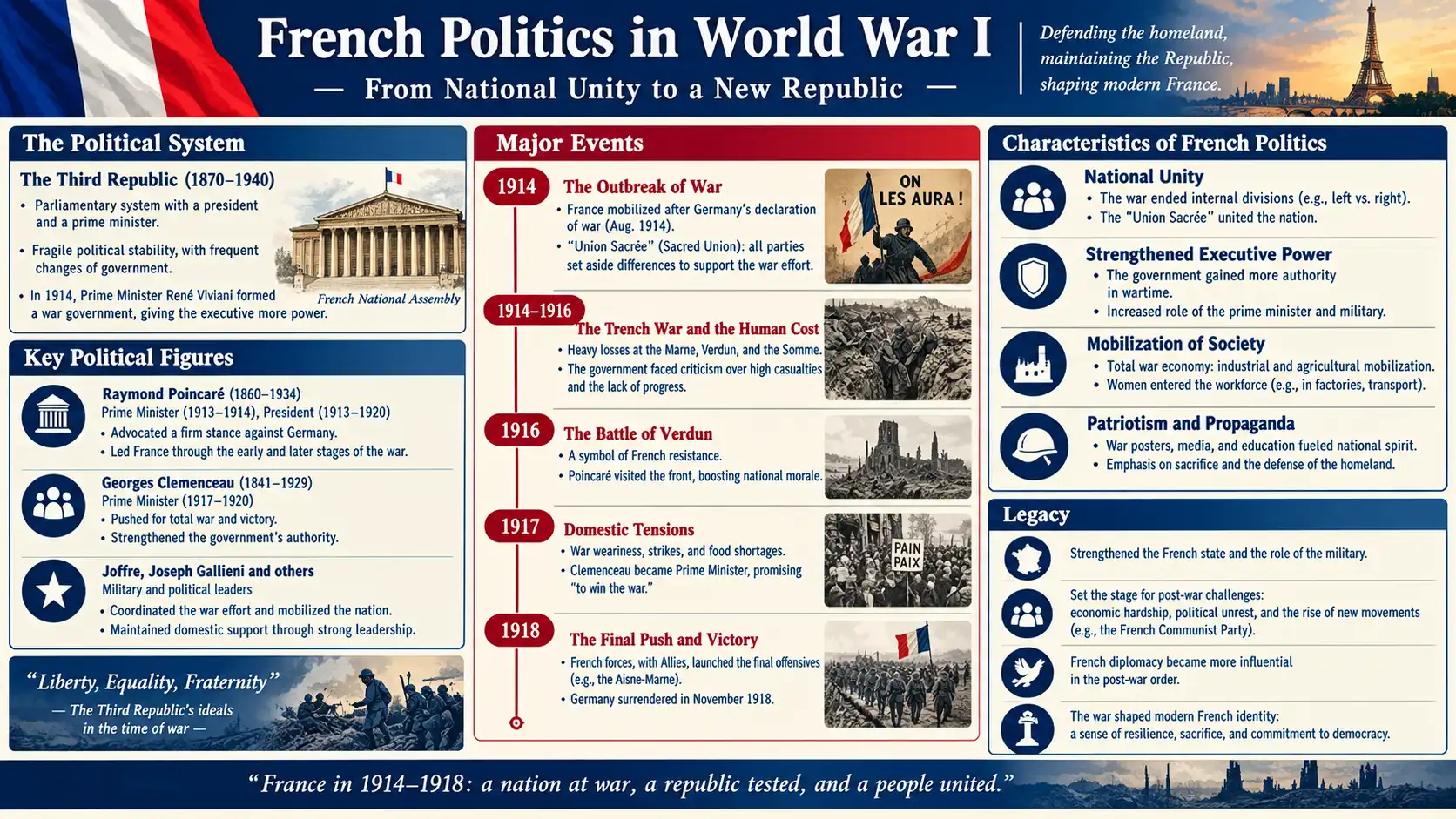
French politics during World War I transformed through the Union Sacrée, a national political truce bridging deep ideological divides. Initially led by René Viviani, the government faced political instability, economic disruption, and severe military pressure, leading to frequent cabinet shifts. Parliamentary oversight remained vital in balancing civil authority against military leadership. By 1917, as war weariness, industrial strikes, and mutinies threatened national morale, the political landscape consolidated under decisive civilian control. Georges Clemenceau’s accession marked a pivot toward total war, suppressing defeatism and mobilizing every domestic resource until total victory was secured.
People
Birth
Death
Origin
Age (Death)
| 1841 | |
|---|---|
| 1859 | |
| 1860 | |
| 1862 | |
| 1863 | |
| 1863 |
Timeline
| Category | |
|---|---|
| Element |
| Year | French Politics |
|---|---|
| 1841 |
Birth of Georges Clemenceau (Period: September 28, 1841, Location: Mouilleron-en-Pareds (now Mouilleron-Saint-Germain), France)
|
| 1859 |
Birth of Alexandre Millerand (Period: February 10, 1859, Location: Paris, France)
|
| 1860 |
Birth of Raymond Poincaré (Period: August 20, 1860, Location: Bar-le-Duc, France)
|
| 1861 |
American Civil War
|
| 1862 |
Republican Activities and Arrest Under the Second Empire
Birth of Aristide Briand (Period: March 28, 1862, Location: Nantes, France)
|
| 1863 |
Birth of Joseph Caillaux (Period: March 30, 1863, Location: Le Mans, France)
Birth of René Viviani (Period: November 8, 1863, Location: Sidi Bel Abbès, Algeria)
|
| 1865 |
Stay in the United States
Obtaining Doctorate in Medicine (Georges Clemenceau)
|
| 1869 |
Marriage (Georges Clemenceau, Mary Eliza Plummer)
|
| 1870 |
Assuming Office as Mayor of Montmartre (Georges Clemenceau)
|
| 1871 |
First Election to the National Assembly (Georges Clemenceau)
Paris Commune
Paris Commune and the Execution of Generals Lecomte and Thomas
|
| 1880 |
Beginning of Career as a Lawyer
Founding of "La Justice"
Activities as Leader of the Radical Republicans
Beginning of Legal Practice in Paris
Beginning of Career as Lawyer and Socialist Activist
|
| 1881 |
Beginning of Practice at the Paris Bar
|
| 1883 |
Decazeville Miners' Strike
|
| 1884 |
Election to the Paris Municipal Council (Alexandre Millerand)
|
| 1885 |
First Election to the National Assembly (Alexandre Millerand)
|
| 1887 |
First Election to the Chamber of Deputies (Raymond Poincaré)
|
| 1888 |
Beginning of Bureaucratic Career as Inspector of Finances
|
| 1891 |
Fourmies Massacre
|
| 1892 |
Panama Scandals
Carmaux Miners' Strike
|
| 1893 |
First Cabinet Appointment (Raymond Poincaré)
First Election to the Chamber of Deputies (René Viviani)
|
| 1894 |
Dreyfus Affair
Support for the General Strike at the Nantes Workers' Congress
|
| 1896 |
Saint-Mandé Speech (Alexandre Millerand)
|
| 1897 |
Intervention in the Dreyfus Affair and Publication of "J'Accuse...!"
|
| 1898 |
First Election to Parliament (Joseph Caillaux)
Marriage (Alexandre Millerand, Jeanne Levayer)
|
| 1899 |
Millerand Affair
Assuming Office as Minister of Commerce, Industry, Posts and Telegraphs (Alexandre Millerand)
First Appointment as Minister of Finance (Joseph Caillaux)
|
| 1900 |
Emergence as Leader of the Radical Party
|
| 1902 |
Formation of the Democratic Republican Alliance
Assuming a Seat in the Senate (Georges Clemenceau)
|
| 1903 |
Assuming a Seat in the Senate (Raymond Poincaré)
|
| 1904 |
Participation in the Founding of "L'Humanité"
Expulsion from the Socialist Party and Shift to the Right
Marriage (Raymond Poincaré, Henriette Adeline Benucci)
|
| 1905 |
Church Property Inventories Issue Surrounding the Separation of Church and State
Passage of the Law on the Separation of the Church and the State
|
| 1906 |
Assuming Office as Minister of Labour and Social Security (René Viviani)
Assuming Office as Minister of Public Instruction, Fine Arts, and Worship (Aristide Briand)
Tax Reforms as Minister of Finance
Marriage (René Viviani, Isabelle de Boueille-Lapeyrère)
Assuming Office as Minister of the Interior (Georges Clemenceau)
Marriage (Joseph Caillaux, Berthe Gueydan)
First Term as Prime Minister
|
| 1907 |
1907 Revolt of the Languedoc Winegrowers
Languedoc Winegrowers' Revolt
|
| 1908 |
Bosnian Crisis
|
| 1909 |
Assuming Office as Minister of Public Works, Posts and Telegraphs (Alexandre Millerand)
First Premiership (Aristide Briand)
|
| 1910 |
Passage of the Workers' and Peasants' Pensions Law
|
| 1911 |
Agadir Crisis
Co-founding of the Republican-Socialist Party
Second Moroccan Crisis (Agadir Incident)
Assuming Office as Prime Minister (Joseph Caillaux)
Marriage (Joseph Caillaux, Henriette Raynouard)
Agadir Agreement
|
| 1912 |
Poincaré's Accession to Premiership and Foreign Policy Toward Germany and Russia (Raymond Poincaré)
Collapse of the Caillaux Administration
Diplomatic Activities After the First Balkan War
Political Struggle Over the Three-Year Law
First Appointment as Minister of War (Alexandre Millerand)
Assuming the Premiership (Raymond Poincaré)
|
| 1913 |
Assuming Office as Minister of Public Instruction and Fine Arts (René Viviani)
Assuming the French Presidency (Raymond Poincaré)
Assuming Office as Minister of Finance in the Second Doumergue Cabinet (Joseph Caillaux)
|
| 1914 |
Caillaux Affair
National Unity During World War I
Advocacy for the War Effort During World War I
Political Conflict Over the Salonika Campaign During World War I
Pacifist Activities During World War I
Mission to Argentina During World War I
Fatal Shooting of Gaston Calmette
Assuming Office as Prime Minister of France (René Viviani)
July Crisis
Trial of Henriette Caillaux
Passage of the Income Tax Law
Formation of the "Sacred Union" (Union Sacrée) in France at the Outbreak of World War I
Reorganization of the War Cabinet During World War I
Minister of War During World War I
Government Relocation Before the Battle of the Marne in 1914
|
| 1915 |
Failure of the 1915 Western Front Offensives and Crisis of the Viviani Cabinet
Promotion of the Salonika Expedition
War Leadership Consultations with French Military Commanders
Resignation as Prime Minister (René Viviani)
Assuming the Premiership During World War I (Aristide Briand)
|
| 1917 |
Caillaux Treason Case
Mission to Italy
Crisis and Resignation of the Briand Government (Aristide Briand)
Resignation as Prime Minister (Aristide Briand)
Diplomatic Mission to the United States
Appointment of Clemenceau as Prime Minister
|
| 1918 |
Arrest on Treason Charges
|
| 1919 |
Paris Peace Conference
Polish–Soviet War
Administration of Alsace-Lorraine
Formation of the National Block (Bloc National)
Greco-Turkish War
1919 Attempted Assassination of Clemenceau
Support for the Women's Suffrage Bill
Conclusion of the Treaty of Versailles
|
| 1920 |
End of Presidential Term and Chairman of the Reparation Commission (Raymond Poincaré)
Activities at the League of Nations
Franco-Syrian War
Resignation as Prime Minister and Retirement from Politics (Georges Clemenceau)
Assuming Office as Prime Minister and Foreign Minister (Alexandre Millerand)
Trial and Conviction Before the High Court
1920 Presidential Election and Resignation of Paul Deschanel (Alexandre Millerand)
Assuming the French Presidency (Alexandre Millerand)
|
| 1922 |
Second Premiership
Visits to Morocco, Algeria, and Tunisia
|
| 1923 |
Occupation of the Ruhr
Implementation of the Ruhr Occupation
Cessation of Political Activities Due to a Stroke
Évreux Speech (Alexandre Millerand)
|
| 1924 |
Demand for Presidential Resignation by the Left Cartel (Alexandre Millerand)
Return to Politics
Victory of the Left Cartel (Cartel des Gauches)
Resignation as President (Alexandre Millerand)
|
| 1925 |
Return to the Senate
Death of René Viviani
Locarno Treaties
|
| 1926 |
Awarded the Nobel Peace Prize (Aristide Briand)
Third Premiership and Stabilization of the Franc
|
| 1928 |
Kellogg–Briand Pact
|
| 1929 |
Resignation as Prime Minister and Writing of Memoirs (Raymond Poincaré)
Proposal of the "European Union" Concept
Death of Georges Clemenceau
|
| 1930 |
Final Term as Prime Minister (Aristide Briand)
|
| 1932 |
Death of Aristide Briand
|
| 1934 |
Assassination of Louis Barthou
Death of Raymond Poincaré
|
| 1939 |
World War II
|
| 1940 |
Retirement from Politics During World War II (Joseph Caillaux)
Vote of Full Powers on July 10, 1940
|
| 1943 |
Death of Alexandre Millerand
|
| 1944 |
Death of Joseph Caillaux
|
| Unknown |
Marriage (Aristide Briand, No Official Spouse, Period: No official marriage recorded throughout lifetime, Location: N/A)
|
Map
| Category | |
|---|---|
| Element |
Europe
World


Related Links
| Group | List |
|---|---|
| Western Europe | French Politics British Politics Poet and Writer Science and Medicine |
| Central Europe | German Leader Emperors of Austria-Hungary The Sarajevo Incident Science and Medicine |
Comments