Otto Hahn: Discovery of Fission
Otto Hahn: Discovery of Fission

Otto Hahn

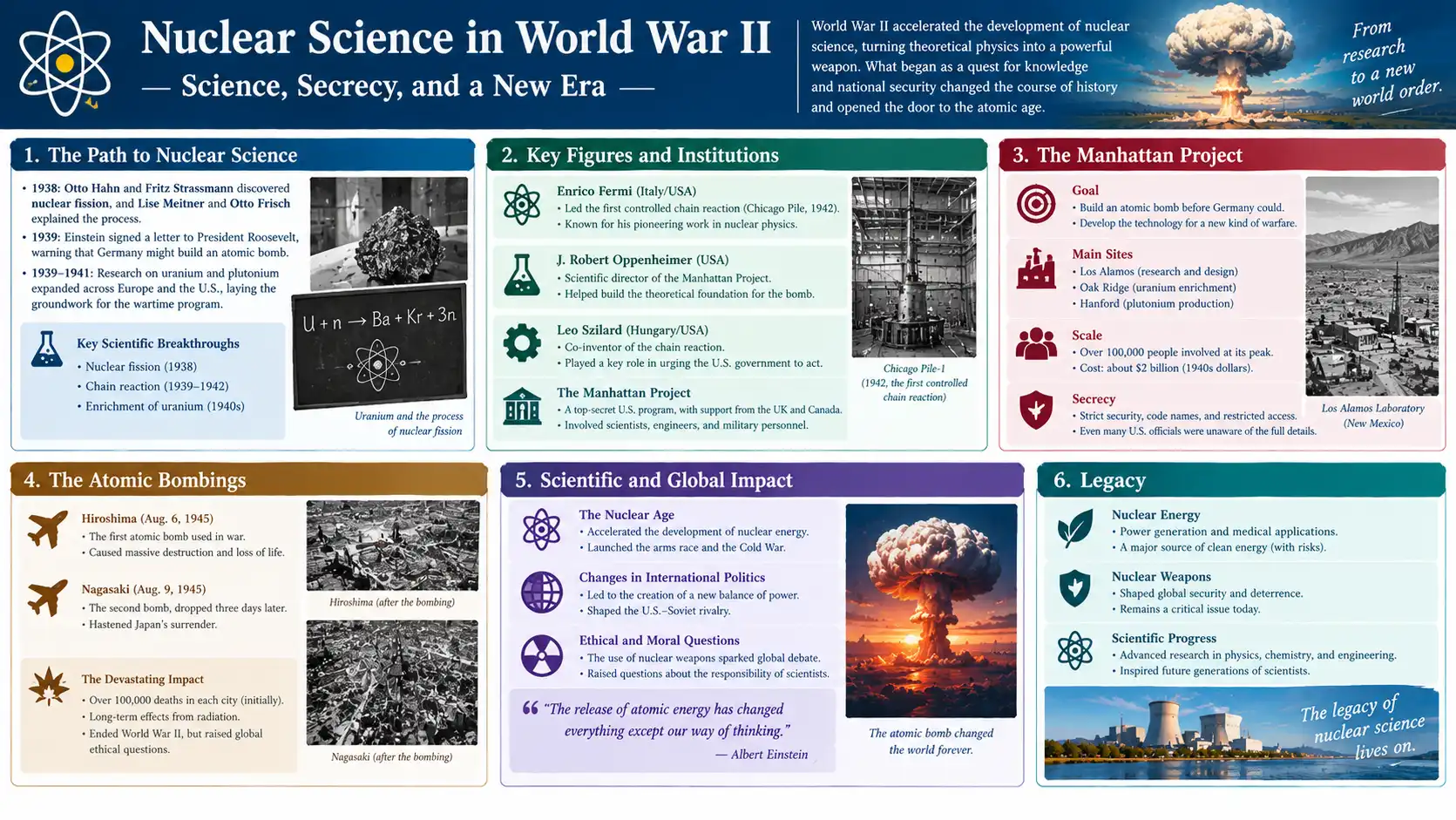
German chemist and radiochemist. He advanced the study of radioactive elements, making major achievements in the study of radiothorium and protactinium, the discovery of nuclear recoil phenomena and nuclear isomers, and dating via the rubidium-strontium method. In collaboration with Lise Meitner and Fritz Strassmann, he discovered nuclear fission of uranium in 1938 and was awarded the Nobel Prize in Chemistry in 1944 for this accomplishment. During World War II, he was involved in German nuclear research, but opposed the persecution of Jewish researchers by the Nazis, and worked toward the reconstruction of the German scientific community and the anti-nuclear weapons movement after the war.

Timeline

Category
Element
Year Otto Hahn
1879
Birth of Otto Hahn (Period: March 8, 1879, Location: Frankfurt am Main (present-day Germany))
1897
Studying Chemistry at the University of Marburg (Age: 17 years old, Period: 1897–1901, Location: Marburg, Germany)
1904
Research under William Ramsay (Age: 24 years old, Period: 1904–1905, Location: London, United Kingdom)
1905
Research with Ernest Rutherford (Age: 25 years old, Period: 1905–1906, Location: Montreal, Canada)
1907
Start of Joint Research with Lise Meitner (Age: 27 years old, Period: 1907–1912, Location: Berlin, Germany)
1912
Appointment as Head of Radioactivity Department at the Kaiser Wilhelm Institute for Chemistry (Otto Hahn, Age: 32 years old, Period: 1912, Location: Berlin-Dahlem, Germany)
1913
Marriage (Otto Hahn, Edith Junghans, Age: 34 years old, Period: March 22, 1913, Location: Szczecin, Poland (formerly Stettin, Germany))
1914
World War I (Age: 34 years old, Period: 1914–1918, Location: Western Front, Belgium and France)
1915
Second Battle of Ypres and Participation in Chemical Warfare (Age: 36 years old, Period: April–May 1915, Location: Ypres, Belgium)
1917
Discovery of Protactinium (Age: 37 years old, Period: 1917–1918, Location: Berlin, Germany)
1921
Discovery of Nuclear Isomerism (Age: 41 years old, Period: 1921, Location: Berlin, Germany)
1933
Persecution of Jewish Researchers by the Nazis and Lise Meitner's Exile (Otto Hahn, Age: 53 years old, Period: 1933–1938, Location: Berlin, Germany)
1934
Uranium Research by Neutron Irradiation (Age: 54 years old, Period: 1934–1938, Location: Berlin, Germany)
1939
World War II (Age: 59 years old, Period: 1939–1945, Location: UK, France, North Africa, Mediterranean, Atlantic, etc.)
Nuclear Research during World War II (Age: 59 years old, Period: 1939–1945, Location: Berlin and other locations in Germany)
1944
Hahn's Nobel Prize in Chemistry (Otto Hahn, Age: 64 years old, Period: 1944–1946, Location: Stockholm, Sweden, and other locations)
1945
Nobel Prize in Chemistry (Otto Hahn, Age: 65 years old, Period: 1945, Location: Stockholm, Sweden)
Farm Hall Internment (Age: 66 years old, Period: July 1945 – January 1946, Location: Farm Hall, England)
1946
President of the Kaiser Wilhelm Society (Age: 66 years old, Period: 1946, Location: Germany)
1948
First President of the Max Planck Society (Age: 68 years old, Period: 1948–1960, Location: Göttingen and surrounding West Germany)
1957
Göttingen Manifesto (Age: 77 years old, Period: 1957, Location: Göttingen, West Germany)
Participation in the Göttingen Manifesto (Age: 77 years old, Period: 1957, Location: Göttingen, West Germany)
1959
Co-founding of the Association of German Scientists (Age: 79 years old, Period: 1959, Location: Berlin, West Germany)
1968
Death of Otto Hahn (Age: 89 years old, Period: July 28, 1968)

Map

Category
Element
Europe World
europe map

Related Links

Other Languages

Comments