Key Confederate Officers Overview
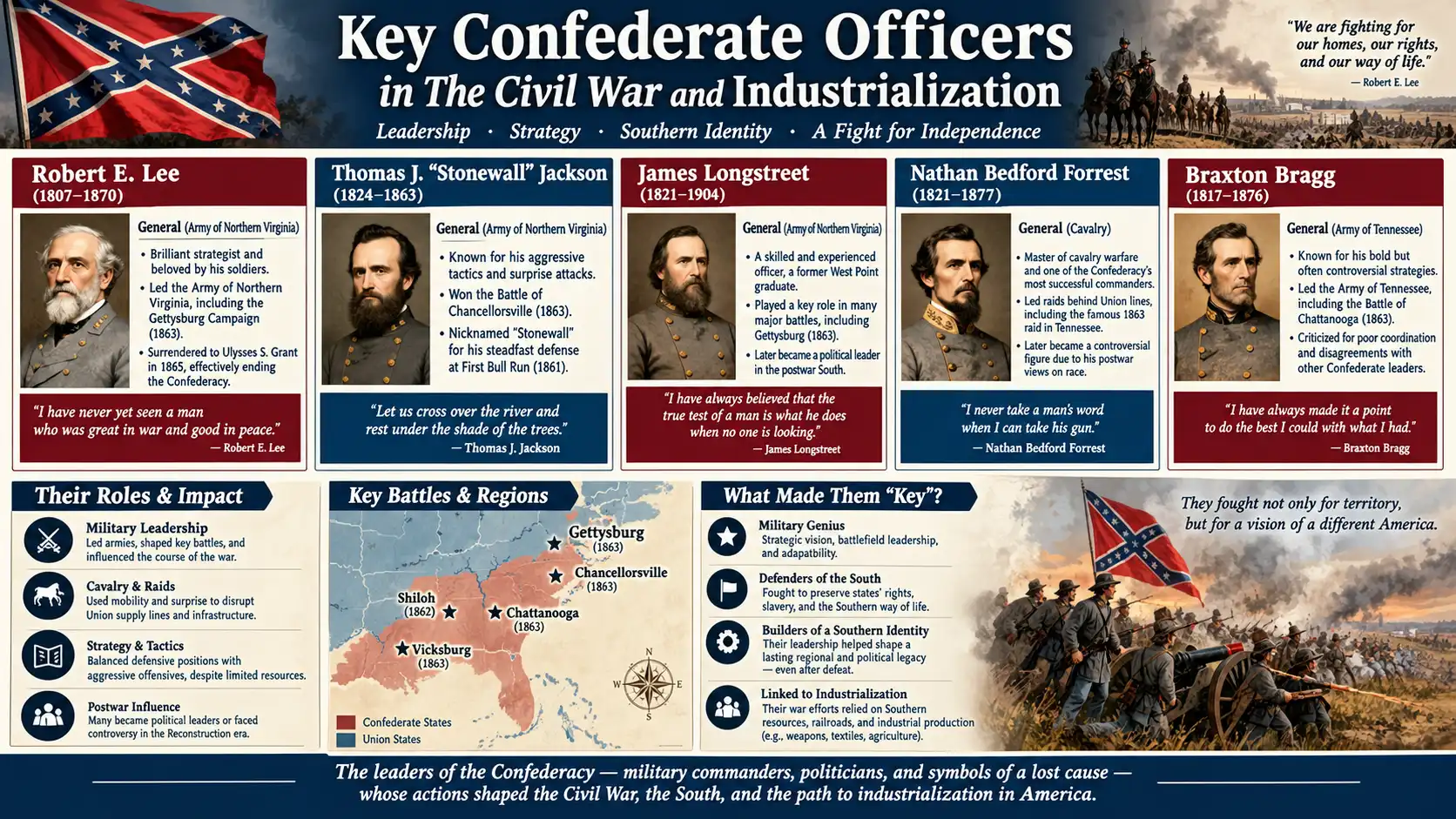
Key Confederate Officers
Key Confederate officers were military leaders who commanded Southern forces during the American Civil War. They played pivotal roles in major battles, utilizing various tactical strategies, and later influenced post-war reconciliation, politics, and historical memory.
People
Birth
Death
Origin
Age (Death)
| 1807 | |
|---|---|
| 1816 | |
| 1817 | |
| 1818 | |
| 1821 | |
| 1821 | |
| 1824 | |
| 1831 | |
| 1832 |
Timeline
| Category | |
|---|---|
| Element |
| Year | Key Confederate Officers |
|---|---|
| 1807 |
Birth of Joseph Egleston Johnston (Period: February 3, 1807, Location: Farmville area, Virginia, United States)
|
| 1816 |
Birth of Jubal Anderson Early (Period: November 3, 1816, Location: Rocky Mount, Virginia, United States)
|
| 1817 |
Birth of Braxton Bragg (Period: March 22, 1817, Location: Warrenton, North Carolina, United States)
|
| 1818 |
Birth of Pierre Gustave Toutant Beauregard (Period: May 28, 1818, Location: Chalmette area (St. Bernard Parish), Louisiana, United States)
|
| 1821 |
Birth of James Longstreet (Period: January 8, 1821, Location: Edgefield area, South Carolina, United States)
Birth of Nathan Bedford Forrest (Period: July 13, 1821, Location: Chapel Hill, Tennessee, United States)
|
| 1824 |
Birth of Thomas Jonathan Jackson (Period: January 21, 1824, Location: Clarksburg, West Virginia, United States)
|
| 1825 |
West Point admission and graduation (Joseph Eggleston Johnston)
|
| 1830 |
Early family support and move to Mississippi (Nathan Bedford Forrest)
|
| 1831 |
Birth of John Bell Hood (Period: June 29, 1831 (though a June 1 date is also suggested), Location: Owingsville, Kentucky, United States)
|
| 1832 |
Birth of John Brown Gordon (Period: February 6, 1832, Location: Thomaston area, Georgia. However, historical records specify the birth place only as as far as Upson County)
|
| 1833 |
West Point admission and graduation (Braxton Bragg)
West Point graduation (Jubal Anderson Early)
|
| 1834 |
West Point admission and graduation (Pierre Gustave Toutant Beauregard)
|
| 1835 |
Second Seminole War
|
| 1837 |
Resignation from the U.S. Army (Joseph Eggleston Johnston)
Combat and reconnaissance operations in Florida (Joseph Eggleston Johnston)
|
| 1838 |
West Point admission and graduation (James Longstreet)
Resignation from the army and practice of law (Jubal Anderson Early)
|
| 1840 |
Building wealth through the slave trade and plantation management (Nathan Bedford Forrest)
|
| 1841 |
Marriage (Pierre Gustave Toutant Beauregard, Marie Antoinette Laure Villeré)
|
| 1842 |
Admission to West Point (Thomas Jonathan Jackson)
|
| 1844 |
Court-martial incident
|
| 1845 |
Killing of Jonathan Forrest and feud with the Matlock brothers
Marriage (Joseph Eggleston Johnston, Lydia McLane)
Marriage (Nathan Bedford Forrest, Mary Ann Montgomery)
|
| 1846 |
Service in the Mexican-American War (Thomas Jonathan Jackson)
Service in the Mexican-American War
|
| 1847 |
Battle of Buena Vista in the Mexican-American War
Assassination attempt plot against Bragg
|
| 1848 |
Frontier service in Texas, New Mexico, etc. (James Longstreet)
Marriage (James Longstreet, Louise Maria Garland)
|
| 1849 |
West Point admission and graduation (John Bell Hood)
Marriage (Braxton Bragg, Eliza Brooks Ellis)
|
| 1850 |
Practice of law and engagement in the coal mining business
|
| 1851 |
Resignation from the U.S. Army
Appointment as professor at the Virginia Military Institute (Thomas Jonathan Jackson)
Studies at the University of Georgia
|
| 1853 |
Western frontier service in the U.S. Army
Marriage to Elinor Junkin
Marriage (Thomas Jonathan Jackson, Elinor Junkin)
|
| 1854 |
Marriage (John Brown Gordon, Rebecca "Fanny" Haralson)
|
| 1856 |
Resignation from the army and sugar plantation management in Louisiana
|
| 1857 |
American Indian Wars
Remarriage to Mary Anna Morrison
Marriage (Thomas Jonathan Jackson, Mary Anna Morrison)
Wound at Devil's River
|
| 1858 |
Drainage and flood control projects in New Orleans
|
| 1859 |
John Brown's raid on Harpers Ferry
|
| 1860 |
Appointment as U.S. Quartermaster General (Joseph Eggleston Johnston)
Marriage (Pierre Gustave Toutant Beauregard, Marguerite Caroline Deslonde)
Reconstruction-era political activity and racial policies
|
| 1861 |
Conflict with Jefferson Davis
Enlistment in the Confederate Army
Surrender of the Louisiana federal arsenal
Appointment as Superintendent of West Point and brief resignation (Pierre Gustave Toutant Beauregard)
Opposition to secession at the Virginia Secession Convention
Appointment as the first brigadier general in the Confederate Army (Pierre Gustave Toutant Beauregard)
Appointment as commander of the Harpers Ferry garrison (Thomas Jonathan Jackson)
Resignation from the U.S. Army and joining the Confederacy (Joseph Eggleston Johnston)
Resignation from the U.S. Army and joining the Confederacy
Joining the Confederacy (Jubal Anderson Early)
Bombardment of Fort Sumter
James Longstreet's resignation from the U.S. Army and joining the Confederacy
Enlistment as a private in the Confederate Army (Nathan Bedford Forrest)
Skirmish at Cedar Lane
Battle of Blackburn's Ford
Earning the nickname "Stonewall" at the First Battle of Bull Run
First Battle of Bull Run
Overall Confederate command at the First Battle of Bull Run (Joseph Eggleston Johnston)
|
| 1862 |
Shenandoah Valley Campaign
Peninsula Campaign
Vicksburg Campaign
Escape from Fort Donelson (Nathan Bedford Forrest)
Command controversy after Shiloh
Siege of Corinth
Battle of Shiloh
Participation in the Shenandoah Valley Campaign (Jubal Anderson Early)
Wound at the Battle of Williamsburg
Severe wound at the Battle of Seven Pines (Joseph Eggleston Johnston)
Battle of Seven Pines
Seven Days Battles and Battle of Gaines' Mill
Seven Days Battles
Murfreesboro raid
Kentucky Campaign and Battle of Perryville
Arrest incident regarding captured ambulances
戦後の歴史的な出来事や人物に関する詳細なイベント・人物名のリストですね。ご指定の通り、文章内の各項目を英語に翻訳し、元の区切り文字である
で接続した文字列を作成しました。
Battle of Second Bull Run
Command disputes and demands for removal within the Army of Tennessee
Battle of Fredericksburg
Battle of Stones River
|
| 1863 |
Defense of Charleston
Operational support for the H.L. Hunley submarine
Battle of Chancellorsville
Accidental friendly fire by own troops at Chancellorsville
Death of Thomas Jonathan Jackson
Tullahoma Campaign
Battle of Gettysburg
Battle of Gettysburg and severe left arm wound
Battle of Chickamauga
Battle of Chickamauga and amputation of the right leg
Knoxville Campaign
Chattanooga Campaign and resignation as army commander (Braxton Bragg)
Appointment as commander of the Army of Tennessee (Joseph Eggleston Johnston)
|
| 1864 |
Appointment as military advisor to President Jefferson Davis (Braxton Bragg)
Fort Pillow incident and massacre
Overland Campaign and corps command (Jubal Anderson Early)
Battle of the Wilderness and promotion to major general
Friendly fire wound in the Battle of the Wilderness
Wound in the Battle of the Wilderness
Battle of Drewry's Bluff
Command dispute over Johnston's removal
1864 Shenandoah Valley Campaign
Battle of Brice's Crossroads
Defense of Petersburg
Atlanta Campaign
Ransom demand of Frederick, Maryland
Confederate invasion of Washington, D.C.
Battle of Tupelo
Relieved of command during the Atlanta Campaign (Joseph Eggleston Johnston)
Appointment as commander of the Army of Tennessee (John Bell Hood)
Memphis raid
Franklin-Nashville Campaign
Successive defeats in the Shenandoah Valley and relief of command
Battle of Cedar Creek
Johnsonville raid
|
| 1865 |
Second Battle of Fort Fisher
Exile after the Civil War (Jubal Anderson Early)
Post-war railroad management (Nathan Bedford Forrest)
Relieved of command of the Army of Tennessee
Return to command in the Carolinas Campaign (Joseph Eggleston Johnston)
Carolinas Campaign and the Battle of Bentonville
Carolinas Campaign and witnessing the Confederate surrender
Battle of Waynesboro and relief from army command (Jubal Anderson Early)
Battle of Bentonville
Attack on Fort Stedman
Appomattox Campaign
Efforts toward ending the Civil War
Battle of Selma
Surrender at Appomattox
Confederate surrender and post-war activities
|
| 1866 |
Appointment as the first Grand Wizard of the Ku Klux Klan (Nathan Bedford Forrest)
|
| 1868 |
Marriage (John Bell Hood, Anna Marie Hennen)
1868 Georgia gubernatorial election (John Brown Gordon)
|
| 1870 |
Political pivot in New Orleans (James Longstreet)
Involvement in the Louisiana Lottery
Formation and spread of the Lost Cause ideology
|
| 1873 |
Establishment of the Southern Historical Society
|
| 1874 |
Publication of "Narrative of Military Operations"
1874 White League uprising and Battle of Liberty Place
|
| 1876 |
Death of Braxton Bragg
|
| 1877 |
Death of Nathan Bedford Forrest
|
| 1878 |
New Orleans yellow fever epidemic and death
|
| 1879 |
Election to the U.S. House of Representatives (Joseph Eggleston Johnston)
Death of John Bell Hood
|
| 1880 |
Appointment as U.S. Minister to the Ottoman Empire (James Longstreet)
Political scandal surrounding his Senate resignation (John Brown Gordon)
|
| 1885 |
Appointment as Federal Railroad Commissioner (Joseph Eggleston Johnston)
|
| 1886 |
Election as Governor of Georgia (John Brown Gordon)
|
| 1890 |
First Commander-in-Chief of the United Confederate Veterans
|
| 1891 |
Attendance at William T. Sherman's funeral (Joseph Eggleston Johnston)
Death of Joseph Egleston Johnston
|
| 1893 |
Death of Pierre Gustave Toutant Beauregard
|
| 1894 |
Death of Jubal Anderson Early
|
| 1897 |
Marriage (James Longstreet, Helen Dortch Longstreet)
|
| 1903 |
Publication of "Reminiscences of the Civil War"
|
| 1904 |
Death of James Longstreet
Death of John Brown Gordon
|
Map
| Category | |
|---|---|
| Element |
United States
World


Comments