British Conservative Party in Cold War

British Conservative Party in Cold War

British Conservative Party

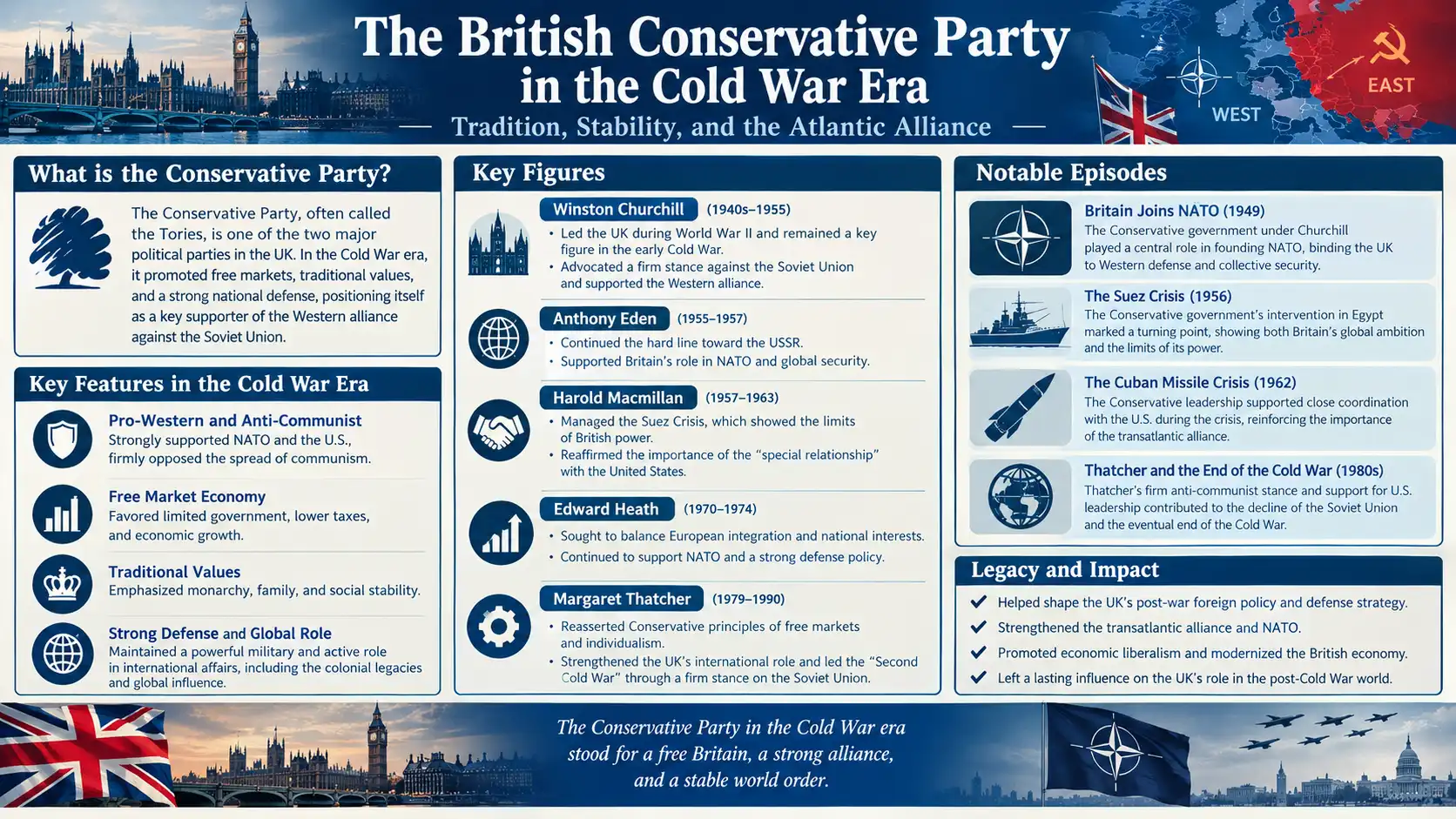
The British Conservative Party played a central role in shaping the Western framework of the Cold War from Winston Churchill to Margaret Thatcher. Balancing strong defense against communist expansion with a commitment to détente, international cooperation, and European integration, the party worked to maintain and project Britain's global influence amidst a shifting international order.

People

Birth Death Origin Age (Death)
1874
1894
1897
1903
1916
1925
1943

Timeline

Category
Element
Year British Conservative Party
1874
Birth of Winston Churchill (Period: November 30, 1874, Location: Woodstock, Oxfordshire, England)
1894
Birth of Harold Macmillan (Period: February 10, 1894, Location: London, England)
1897
Birth of Anthony Eden (Period: June 12, 1897, Location: Ferryhill, County Durham, England (birthplace Rushyford, current post town Ferryhill))
1903
Birth of Alec Douglas-Home (Period: July 2, 1903, Location: London)
1914
Military service in World War I
1916
Birth of Edward Heath (Period: July 9, 1916, Location: Broadstairs (Kent, England))
Wound at the Battle of the Somme
1920
Marriage (Harold Macmillan, Lady Dorothy Cavendish)
1924
First election to Parliament
1925
Birth of Margaret Thatcher (Period: October 13, 1925, Location: Grantham)
1930
Opposition to appeasement
1931
First election as Member of Parliament for the House of Commons
1936
Anti-appeasement activities at Oxford University
Marriage (Alec Douglas-Home, Elizabeth Hester Alington)
1937
Appointment as Parliamentary Private Secretary to Prime Minister Chamberlain
Witnessing of the Nuremberg Rally
1938
Munich Conference
1939
1940
Appointment as Parliamentary Secretary to the Ministry of Supply
Interruption of political activity due to spinal tuberculosis
1941
Military service in World War II
1942
Appointment as Minister of State for Northern Africa and the Mediterranean
1943
Activities as a diplomat and security theorist during World War II
Majored in chemistry at Oxford University
Birth of John Major (Period: March 29, 1943, Location: London (St Helier district))
1944
Normandy landings
1945
First election as a Member of Parliament
1947
Worked as a chemical researcher
1950
First election as Member of Parliament
1951
Mass housing construction as Minister of Housing
First candidacy for Parliament
Succeeded as the 14th Earl of Home
Marriage (Margaret Thatcher, Denis Thatcher)
1955
Appointment as Foreign Secretary
Appointment as Commonwealth Secretary
Appointment as Conservative Chief Whip
1956
Suez Crisis
1957
Appointment as Prime Minister
Nuclear weapons policy and strengthening of Anglo-American nuclear cooperation
1959
Activities as Minister of Labour and Lord President of the Council
Victory in the 1959 general election
Member of Parliament for Finchley
1960
Establishment of the European Free Trade Association
Northern Ireland conflict
UK's EEC membership negotiations and French veto
Wind of Change speech
Appointment as Foreign Secretary
1961
Application for membership in the European Economic Community
Berlin Crisis and construction of the Berlin Wall
1962
Skybolt Crisis
Vassall affair
Cuban Missile Crisis
1963
Indonesian-Malaysian confrontation
Profumo affair
Partial Nuclear Test Ban Treaty
Signing of the Partial Nuclear Test Ban Treaty
Appointment as British Prime Minister
1964
1964 United Kingdom general election
1965
Resignation as Conservative Party leader and leadership election reform
Election as Conservative Party leader
Rhodesia's Unilateral Declaration of Independence
1967
Car accident during stay in Nigeria
1968
D'Oliveira affair
Election as Lambeth Borough Councillor
1970
Return to office as Foreign and Commonwealth Secretary
Appointment as Secretary of State for Education and Science
Resignation from the premiership
Victory in the 1970 general election and appointment as Prime Minister
Marriage (John Major, Norma Major)
1972
UK accession to the European Economic Community
Bloody Sunday
1973
Miners' strike and three-day week
Sunningdale Agreement
1974
Return to the House of Lords and retirement from politics
1974 general election and resignation as Prime Minister
IRA bomb attack on home
1975
Referendum campaign supporting European Economic Community membership
Resignation as Conservative Party leader
1976
Establishment of the "Iron Lady" moniker
Resignation as Prime Minister
1977
Death of Anthony Eden
1978
Winter of Discontent
1979
1979 United Kingdom general election
Appointment as Britain's first female Prime Minister
1982
Falklands War
1983
Conservative landslide victory in the 1983 general election
1984
Miners' strike
Brighton hotel bombing
1985
Appointment as Parliamentary Under-Secretary of State for Social Security
Anglo-Irish Agreement
1986
Financial market "Big Bang"
1987
Third consecutive victory in the 1987 general election
1989
Political crisis over the introduction of the poll tax
Appointment as Chancellor of the Exchequer
1990
Gulf War
Conservative Party leadership election and resignation of Thatcher
Resignation of Margaret Thatcher and Conservative Party leadership election
Resignation as Prime Minister and Conservative Party leader
1991
Introduction of the Citizen's Charter
Maastricht Treaty negotiations
IRA mortar attack on 10 Downing Street
1992
Appointment as "Father" of the House of Commons
Entry into the House of Lords as a life peer
Conservative victory in the 1992 general election
Black Wednesday
1993
Advancement of the Northern Ireland peace process
Privatization of British Railways by the Conservative government
Downing Street Declaration
1995
1995 Conservative Party leadership election
Re-election as Conservative Party leader in 1995
1997
Conservative defeat in the 1997 general election
2001
Retirement as a Member of Parliament
2005
Death of Edward Heath
2013
2026
Death of John Major
Unknown
Marriage (Edward Heath, none, Period: No marriage history, Location: None)

Map

Category
Element
Europe World
europe map

Related Links

Other Languages

Comments