NATO's Role in the Cold War
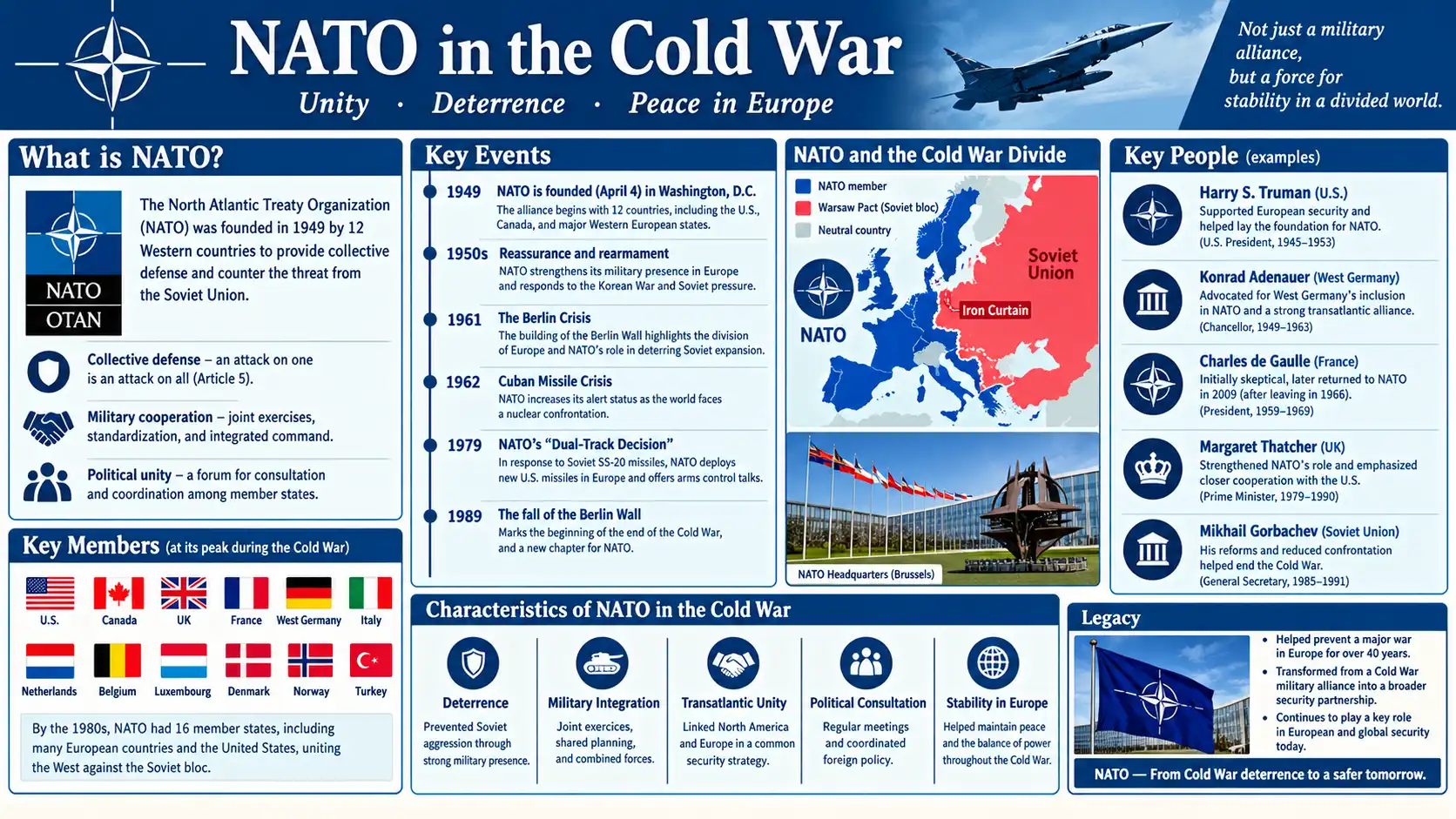
NATO
Established in 1949, NATO served as the primary collective defense alliance for Western nations against Soviet expansion throughout the Cold War. It anchored European security, facilitated critical military cooperation, and deterred communist aggression. The alliance was pivotal during major crises like the Berlin Blockade and managed nuclear deterrence policies, ultimately laying the foundation for transatlantic stability and European integration.
People
Birth
Death
Origin
Age (Death)
| 1874 | |
|---|---|
| 1876 | |
| 1881 | |
| 1890 | |
| 1894 | |
| 1899 | |
| 1907 | |
| 1918 | |
| 1925 |
Timeline
| Category | |
|---|---|
| Element |
| Year | NATO |
|---|---|
| 1874 |
Birth of Winston Churchill (Period: November 30, 1874, Location: Woodstock, Oxfordshire, England)
|
| 1876 |
Birth of Konrad Adenauer (Period: January 5, 1876, Location: Cologne, North Rhine-Westphalia, Federal Republic of Germany)
|
| 1881 |
Birth of Ernest Bevin (Period: March 9, 1881, Location: Winsford, Somerset, England (birthplace; near Exeter))
|
| 1890 |
Birth of Charles de Gaulle (Period: November 22, 1890, Location: Lille (Nord, France))
|
| 1894 |
Birth of Harold Macmillan (Period: February 10, 1894, Location: London, England)
|
| 1899 |
Birth of Paul-Henri Spaak (Period: January 25, 1899, Location: Schaerbeek, Brussels-Capital Region, Belgium)
|
| 1904 |
Marriage (Konrad Adenauer, Emma Weyer)
|
| 1906 |
Beginning of political activities in the Cologne City Council
|
| 1907 |
Birth of Pierre Mendès France (Period: January 11, 1907, Location: Paris, French Republic)
|
| 1914 |
Military service in World War I
|
| 1916 |
Wound at the Battle of the Somme
|
| 1917 |
Assumption of office as Mayor of Cologne
|
| 1918 |
Birth of Helmut Schmidt (Period: December 23, 1918, Location: Hamburg, Federal Republic of Germany (Barmbek district at the time))
|
| 1919 |
Marriage (Konrad Adenauer, Auguste “Gussie” Zinsser)
|
| 1920 |
Joining the Belgian Labour Party and election to the Chamber of Representatives
Beginning of activities as a lawyer
Marriage (Harold Macmillan, Lady Dorothy Cavendish)
|
| 1921 |
Marriage (Paul-Henri Spaak, Marguerite Malevez)
|
| 1924 |
First election to Parliament
|
| 1925 |
Birth of Margaret Thatcher (Period: October 13, 1925, Location: Grantham, Lincolnshire, England, United Kingdom)
|
| 1929 |
Attempted assassination of Crown Prince Umberto by Fernando de Rosa
|
| 1930 |
Opposition to appeasement
|
| 1932 |
First election as a member of the National Assembly
|
| 1933 |
Political exclusion under the Nazi regime
Dismissal of the Mayor of Cologne by the Nazi regime
Marriage (Pierre Mendès France, Liliane “Lily” Cicurel)
|
| 1934 |
Night of the Long Knives
|
| 1935 |
Appointment as Minister of Transport
Assumption of office as Mayor of Louviers
|
| 1937 |
Graduation from the Lellwack School in Hamburg and start of military service
|
| 1938 |
First term as Prime Minister of Belgium
|
| 1939 | |
| 1940 |
Appointment as Parliamentary Secretary to the Ministry of Supply
Trial and detention by the Vichy regime
German invasion of Belgium
French defeat and establishment of the Vichy regime
Relocation of the Belgian government in exile to London
|
| 1941 |
Joining Free France
|
| 1942 |
Appointment as Minister of State for Northern Africa and the Mediterranean
Marriage (Helmut Schmidt, Hannelore Glaser, commonly known as Loki Schmidt)
|
| 1943 |
Chemical research at the University of Oxford
|
| 1944 |
July 20 plot to assassinate Hitler
Arrests after the July 20 plot to assassinate Hitler
Assumption of office as Minister of National Economy
Promotion of the Benelux Customs Union concept
|
| 1945 |
Formation and leadership of the Christian Democratic Union (CDU)
Study of economics and political science at the University of Hamburg
Reappointment and dismissal as Mayor of Cologne after World War II
First election as a Member of Parliament
|
| 1946 |
Election as the first President of the United Nations General Assembly
First Indochina War
Joining the Social Democratic Party of Germany (SPD)
|
| 1947 |
Second term as Prime Minister of Belgium and post-war reforms
|
| 1948 |
Chairmanship of the Parliamentary Council, leading the formulation of the Basic Law
|
| 1949 |
Assumption of office as President of the Consultative Assembly of the Council of Europe
Assumption of office as the first Chancellor of West Germany
|
| 1951 |
Mass housing construction as Minister of Housing
Death of Ernest Bevin
Marriage (Margaret Thatcher, Denis Thatcher)
|
| 1952 |
President of the Common Assembly of the European Coal and Steel Community (ECSC)
|
| 1953 |
First election as a member of the Bundestag
|
| 1954 |
Algerian War
Battle of Dien Bien Phu
Government crisis in the Fourth Republic and formation of the Mendès France Cabinet
Geneva Accords for ending the Indochina War
Carthage speech recognizing Tunisia's expanded autonomy
Response to the European Defence Community initiative
Outset of the Algerian War of Independence
|
| 1955 |
Appointment as Foreign Secretary
Spaak Committee and preparation for the European Economic Community
Resignation of the Mendès France Cabinet
West Germany's accession to NATO
|
| 1956 |
Suez Crisis
|
| 1957 |
Appointment as Prime Minister
Nuclear weapons policy and strengthening of Anglo-American nuclear cooperation
Assumption of office as Secretary General of the North Atlantic Treaty Organization (NATO)
|
| 1958 |
Opposition to the Fifth Republic and participation in left-wing politics
Signing of the Treaty of Rome and establishment of the European Economic Community
|
| 1959 |
Victory in the 1959 general election
|
| 1960 |
Establishment of the European Free Trade Association
Wind of Change speech
|
| 1961 |
Application for membership in the European Economic Community
|
| 1962 |
Skybolt Crisis
Vassall affair
Response to the Hamburg storm flood disaster
Hamburg storm flood disaster
|
| 1963 |
Indonesian-Malaysian confrontation
Profumo affair
Reconciliation with France and the Élysée Treaty
Partial Nuclear Test Ban Treaty
Departure from office as Federal Chancellor
|
| 1965 |
Death of Winston Churchill
Marriage (Paul-Henri Spaak, Simone Rickaert-Hotlet-Dear)
|
| 1966 |
Retirement from Belgian politics
|
| 1967 |
Death of Konrad Adenauer
|
| 1969 |
Assumption of office as Federal Minister of Defence
Assumption of office as Federal Chancellor of West Germany
|
| 1970 |
Assumption of office as Secretary of State for Education and Science
Death of Charles de Gaulle
|
| 1971 |
Marriage (Pierre Mendès France, Marie-Claire de Fleurieu)
|
| 1972 |
Assumption of office as Federal Minister of Finance
Death of Paul-Henri Spaak
|
| 1975 |
Contribution to the institutionalization of the G7 summits
Assumption of office as Leader of the Conservative Party
|
| 1976 |
Resignation as Prime Minister
|
| 1977 |
Response to the German Autumn (Red Army Faction crisis)
German Autumn (Deutscher Herbst)
Lufthansa Flight 181 hijacking
|
| 1978 |
Establishment of the European Monetary System (EMS)
|
| 1979 |
Assumption of office as Prime Minister and promotion of Thatcherism
Political conflict surrounding the NATO Double-Track Decision
Support for the NATO Double-Track Decision
|
| 1980 |
Introduction of the Right to Buy housing scheme
|
| 1982 |
Recapture of the Falkland Islands and victory in the general election
Falklands War
Death of Pierre Mendès France
|
| 1983 |
Activities as an editor for *Die Zeit*
|
| 1984 |
Miners' strike
Brighton hotel bombing
Sino-British Joint Declaration and agreement on the handover of Hong Kong
|
| 1985 |
Westland affair
Signing of the Anglo-Irish Agreement
|
| 1986 |
Big Bang and deregulation of financial markets
Death of Harold Macmillan
|
| 1987 |
Third general election victory
|
| 1988 |
Anti-poll tax (community charge) protests
Bruges Speech
|
| 1992 |
Establishment of the Helmut Schmidt Foundation
|
| 2013 |
Death of Margaret Thatcher
|
| 2015 |
Death of Helmut Schmidt
|
Map
| Category | |
|---|---|
| Element |
Europe
World


Related Links
| Group | List |
|---|---|
| Western Europe | NATO British Conservative Party British Labour Party Culture and Thought Science and Technology |
| Central Europe | The Division of Germany Prague Spring Fall of the Berlin Wall Literature and Thought Arts & Film |
Comments