Southern Politicians Era
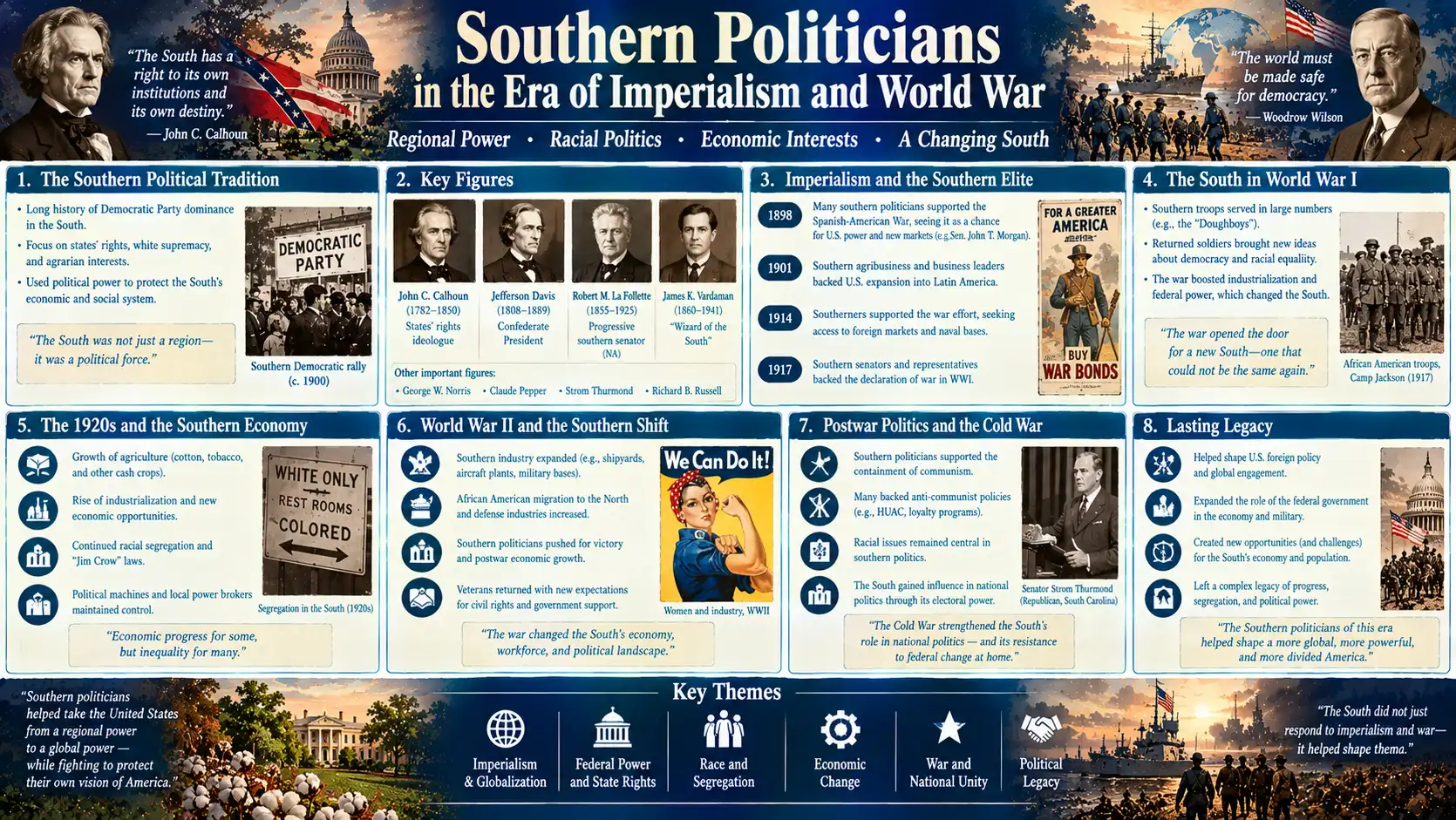
Southern politician
Southern politicians played a pivotal role in shaping U.S. foreign and economic policy during the era of imperialism and total war. Leveraging congressional seniority, they led key financial reforms, backed internationalist policies, and guided critical legislation through both World Wars and the New Deal.
People
Birth
Death
Origin
Age (Death)
| 1858 | |
|---|---|
| 1868 | |
| 1877 | |
| 1877 | |
| 1881 | |
| 1882 | |
| 1900 |
Timeline
| Category | |
|---|---|
| Element |
| Year | Southern politician |
|---|---|
| 1858 |
Birth of George Carter Glass (Period: January 4, 1858, Location: Lynchburg, Virginia, United States)
|
| 1868 |
Birth of John Nance Garner (Period: November 22, 1868, Location: Near Detroit, Texas, United States)
|
| 1877 |
Birth of Thomas Terry Connally (Period: August 19, 1877, Location: Near Hewitt, Texas, United States)
Birth of Alben William Barkley (Period: November 24, 1877, Location: Near Lowes, Kentucky, United States)
|
| 1880 |
Beginning of Career as a Journalist and Editor (Carter Glass)
|
| 1881 |
Birth of Byron Patton Harrison (Period: August 29, 1881, Location: Crystal Springs, Mississippi, United States)
|
| 1882 |
Birth of James Francis Byrnes (Period: May 2, 1882, Location: Charleston, South Carolina, United States)
|
| 1886 |
Marriage (Carter Glass, Aurelia McDearmon Caldwell)
|
| 1893 |
Assumption of Office as Uvalde County Judge (John Nance Garner)
|
| 1895 |
Marriage (John Nance Garner, Mariette Rheiner Garner)
|
| 1898 | |
| 1899 |
Assumption of Office as Virginia State Senator (Carter Glass)
Assumption of Office as Texas State Representative (John Nance Garner)
|
| 1900 |
Birth of Claude Denson Pepper (Period: September 8, 1900, Location: Near Dudleyville, Alabama, United States)
|
| 1901 |
Constitution-Making Convention of Virginia
Assumption of Office as Texas State Representative (Tom Connally)
|
| 1902 |
Assumption of Office as U.S. Representative (Carter Glass)
|
| 1903 |
Trial of the James H. Tillman Murder Case
Enactment of the Texas Antitrust Law
Assumption of Office as U.S. Representative (John Nance Garner)
Marriage (Alben W. Barkley, Dorothy Brower)
|
| 1904 |
Marriage (Tom Connally, Louise Clarkson)
|
| 1905 |
Assumption of Office as McCracken County Attorney (Alben W. Barkley)
Marriage (Pat Harrison, Mary Edwina McInnis)
|
| 1906 |
Assumption of Office as District Attorney for the Second Judicial District of Mississippi (Pat Harrison)
Marriage (James Francis Byrnes, Maude Perkins Bush)
|
| 1908 |
Assumption of Office as South Carolina Solicitor (James Francis Byrnes)
|
| 1911 |
Activities as U.S. Representative (James Francis Byrnes)
Assumption of Office as U.S. Representative (Pat Harrison)
|
| 1913 |
Enactment of the Federal Reserve Act
Assumption of Office as U.S. Representative (Alben W. Barkley)
|
| 1914 | |
| 1917 |
Assumption of Office as U.S. Representative (Tom Connally)
|
| 1918 |
Financing World War I
1918 Mississippi Senate Election (Pat Harrison)
Assumption of Office as Secretary of the Treasury (Carter Glass)
|
| 1919 |
Assumption of Office as U.S. Senator (Pat Harrison)
|
| 1920 |
1920 Democratic National Convention Presidential Nomination Contest (Carter Glass)
Assumption of Office as U.S. Senator (Carter Glass)
|
| 1923 |
1923 Kentucky Gubernatorial Democratic Primary Defeat (Alben W. Barkley)
|
| 1924 |
1924 Senate Election Defeat and Political Return (James Francis Byrnes)
1924 Democratic National Convention Keynote Speech (Pat Harrison)
Keynote Speech at the 1924 Democratic National Convention (Pat Harrison)
|
| 1927 |
Assumption of Office as U.S. Senator (Alben W. Barkley)
|
| 1929 |
Response to the Great Depression and Banking Crisis
Assumption of Office as U.S. Senator (Tom Connally)
Assumption of Office as Florida State Representative (Claude Denson Pepper)
Assumption of Office as House Minority Leader (John Nance Garner)
|
| 1930 |
Rotary Dial Telephone Prohibition Resolution in the Senate
Fiscal Policy Conflict Over the New Deal
|
| 1931 |
Support for the New Deal as U.S. Senator (James Francis Byrnes)
Assumption of Office as Speaker of the House (John Nance Garner)
|
| 1932 |
Enactment of the Glass-Steagall Act
Support for Franklin D. Roosevelt
1932 Democratic National Convention Presidential Nomination Contest
|
| 1933 |
Opposition to Franklin D. Roosevelt Regarding the New Deal
Assumption of Office as Senate Committee on Appropriations Chairman (Carter Glass)
Assumption of Office as Senate Finance Committee Chairman (Pat Harrison)
Cooperation in Congressional Enactment of the New Deal
Assumption of Office as 32nd Vice President of the United States (John Nance Garner)
|
| 1935 |
Involvement in the Enactment of the Social Security Act
|
| 1936 |
Assumption of Office as U.S. Senator (Claude Denson Pepper)
Re-election in the 1936 Presidential Election (John Nance Garner)
Marriage (Claude Denson Pepper, Irene Mildred Webster)
|
| 1937 |
Filibuster Against Anti-Lynching Bills
1937 Anti-Lynching Bill Filibuster
Assumption of Office as Senate Democratic Leader (Alben W. Barkley)
Defeat in the Democratic Majority Leader Selection
Conflict Surrounding the 1937 Judicial Procedures Reform Bill
Opposition to the Judicial Procedures Reform Bill of 1937 (John Nance Garner)
Conflict Surrounding the 1937 Democratic Senate Majority Leader Selection
|
| 1938 |
1938 Anti-Lynching Bill Filibuster
1938 Intraparty Conflict and the "Conservative Purge" Issue
|
| 1939 |
Selection as Most Influential Senator in 1939 (Pat Harrison)
|
| 1940 |
Promotion of the Lend-Lease Act
1940 Democratic Presidential Nomination Contest
Challenge for the 1940 Presidential Nomination (John Nance Garner)
Marriage (Carter Glass, Mary Scott Meade)
|
| 1941 |
Chairman of the Senate Foreign Relations Committee (Tom Connally)
Enactment of the Lend-Lease Act in 1941
Retirement from Politics and Later Years in Uvalde (John Nance Garner)
Assumption of Office as President pro tempore of the Senate (Pat Harrison)
Death of Byron Patton Harrison
Appointment to the U.S. Supreme Court (James Francis Byrnes)
Assumption of Office as President pro tempore of the Senate (Carter Glass)
|
| 1942 |
Resignation as U.S. Supreme Court Associate Justice (James Francis Byrnes)
Wartime Economic Control as Director of Economic Stabilization (James Francis Byrnes)
Filibuster Against Poll Tax Abolition
Promotion of Wartime Medical and Health Policies
Marriage (Tom Connally, Lucille Sanderson Sheppard)
|
| 1943 |
Establishment of Total War Structure as Director of War Mobilization
Enactment of the Smith-Connally Act
|
| 1944 |
1944 Conflict with President Roosevelt and Resignation as Senate Majority Leader (Alben W. Barkley)
Recommendation for Vice Presidential Candidate at the 1944 Democratic National Convention (Alben W. Barkley)
|
| 1945 |
Assumption of Office as Secretary of State (James Francis Byrnes)
San Francisco Conference and Creation of the United Nations
Visit to the Soviet Union and Meeting with Stalin
Potsdam Conference
|
| 1946 |
Participation in the United Nations General Assembly
Death of George Carter Glass
Stuttgart Speech (James Francis Byrnes)
|
| 1947 |
Support for the Truman Doctrine, Marshall Plan, and NATO
|
| 1948 |
Opposition Surrounding the 1948 Democratic Presidential Nominee Selection
Vice Presidential Nomination at the 1948 Democratic National Convention
|
| 1949 |
Assumption of Office as 35th Vice President of the United States (Alben W. Barkley)
Marriage (Alben W. Barkley, Jane Rucker Hadley)
|
| 1950 |
1950 Pepper-Smathers Senate Primary
Korean War
Response to the Korean War
|
| 1951 |
Assumption of Office as Governor of South Carolina (James Francis Byrnes)
|
| 1952 |
Withdrawal from the 1952 Presidential Election (Alben W. Barkley)
|
| 1954 |
Opposition to Brown v. Board of Education Decision
1954 Senate Return Election (Alben W. Barkley)
|
| 1956 |
Death of Alben William Barkley
Final Speech at the Washington and Lee University Mock Convention (Alben W. Barkley)
|
| 1958 |
1958 Senate Return Election Campaign (Claude Denson Pepper)
|
| 1962 |
Return to the U.S. House of Representatives in 1962
|
| 1963 |
Death of Thomas Terry Connally
|
| 1967 |
Death of John Nance Garner
|
| 1970 |
Efforts Toward Elderly Policies
|
| 1972 |
Death of James Francis Byrnes
|
| 1980 |
The "Pepper Report"
|
| 1983 |
Assumption of Office as House Rules Committee Chairman (Claude Denson Pepper)
|
| 1989 |
Awarded the Presidential Medal of Freedom (Claude Denson Pepper)
Death of Claude Denson Pepper
|
Map
| Category | |
|---|---|
| Element |
United States
World


Comments